
A Verbal Yes Is Not a Booked Job: Closing the Gap After Approval
Roofing contractors lose 20–35% of approved estimates between handshake and deposit because they lack a post-approval process that protects crew capacity.
- Published
- Reading time
- 11 min
- Topics
- roofingsales processestimate workflow
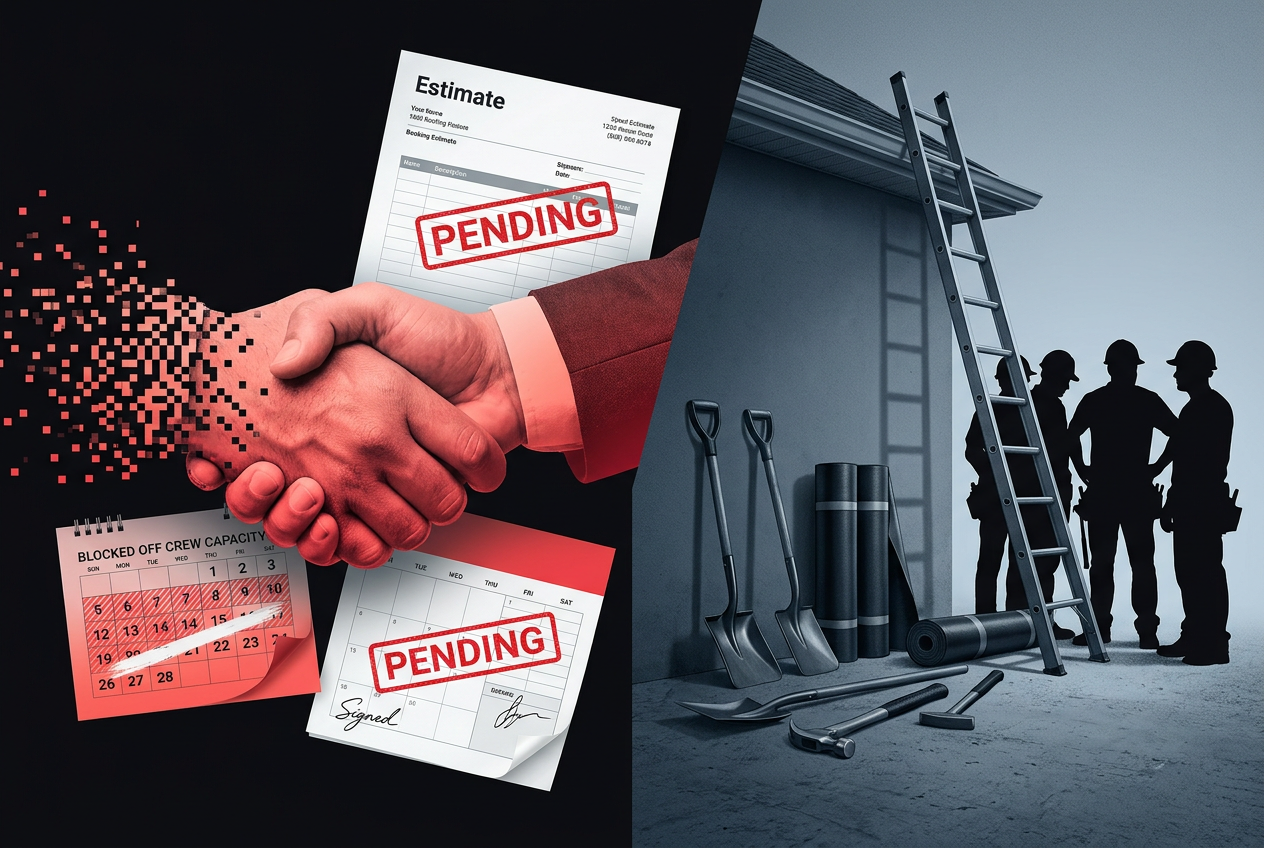
A homeowner tells you the roof looks great, the price is fair, and they want to move forward. You leave the property feeling confident. Three weeks later, they stop returning calls. The crew slot you held sits empty. You've spent hours chasing a deal that was never truly booked.
This is the most expensive blind spot in residential roofing sales. The window between verbal approval and a signed contract with deposit is where 20 to 35 percent of "yes" estimates disappear. Not because the homeowner changed their mind about the roof, but because you didn't structure the path from approval to commitment. A verbal yes protects nothing—not your crew capacity, not your cash flow, not your schedule predictability.
The Real Cost
When a deal stalls after approval, the damage compounds. You've already invested estimate time, material pricing, and follow-up effort. You've likely blocked crew capacity based on the homeowner's verbal timeline. If the project falls apart two weeks later, you've lost both the job and the window to fill that slot with another qualified project.
Worse, you've trained yourself to chase. Every day you spend following up on a stalled approval is a day you're not estimating new projects or managing active jobs. The cost isn't just the lost revenue from one roof—it's the opportunity cost of misallocated attention and the cash flow gap when your schedule has holes you thought were filled.
The problem isn't the homeowner. Most people who say yes at the kitchen table genuinely intend to move forward. But intention without structure decays. If the contract doesn't arrive within hours, if the deposit process feels unclear, if the start date is vague, the homeowner's confidence slowly erodes. They second-guess the price. They wonder if they should get another quote. A neighbor mentions a roofer they used. Momentum dies, and by the time you follow up, the deal is cold.
Define What "Booked" Means
Before you can fix the post-approval process, you need a clear internal definition of a booked job. A verbal yes is not booked. A homeowner who says "send me the contract" is not booked. A signed contract without a deposit is not booked.
A booked job is a signed contract with a non-refundable deposit and a confirmed start date on your schedule. Until all three elements are in place, the estimate is still in play—and at risk.
This distinction matters because it changes your behavior. If you treat a verbal yes as a done deal, you stop following up with urgency. You assume the homeowner will sign and pay when they're ready. You move on to the next estimate. Meanwhile, the homeowner assumes you'll reach out when you're ready to schedule. Both parties wait, and the deal evaporates.
When you define "booked" as signed, paid, and scheduled, you build a process to reach that state within 48 hours of approval. Anything longer and the odds of conversion drop sharply.
The 48-Hour Window
Forty-eight hours is not arbitrary. It's the period during which the homeowner's buying decision is still active in their mind. They've just evaluated their roof, considered the scope, and made a financial commitment in principle. Their emotional and logical buy-in is at its peak.
After 48 hours, doubt creeps in. They talk to a spouse who wasn't present during the estimate. They see an ad for another roofer. They get busy with work and the roof project slides down the priority list. The urgency you created during the estimate fades, and you're back to selling them all over again.
Your goal is to move from verbal approval to deposit before that window closes. This requires a structured sequence of actions, executed immediately, with no gaps.
Step One: Contract Delivery
The contract should be in the homeowner's hands within two hours of verbal approval. Not the next day. Not when you get back to the office. Within two hours.
If you're still at the property when they say yes, send the contract before you leave. Pull it up on your phone or tablet, enter the final details, and email it while standing in the driveway. Walk them through the next step: "I'm sending this to the email you gave me. You'll see the contract and a link to sign electronically. I've also included deposit options—you can pay by card, ACH, or check. Once that's in, I'll lock in your start date and send you a confirmation."
If the homeowner says they need to review it or talk to their spouse, that's fine. But the contract still goes out within two hours. The longer you wait, the more the approval loses momentum.
Use electronic signature software. PDF attachments that require printing, signing, scanning, and emailing back create friction. Every additional step is a chance for the homeowner to delay or disengage. A contract that can be signed on a phone in 90 seconds has a dramatically higher completion rate than one that requires a printer.
Step Two: Deposit Structure
The deposit is the commitment mechanism. It separates real approvals from polite maybes. If a homeowner is willing to put money down, they're bought in. If they hesitate, the approval was softer than it seemed.
Standard deposit amounts in residential roofing range from 10 to 30 percent of the contract value, with 20 percent being the most common. The deposit should be clearly labeled as non-refundable except in cases where you cannot perform the work as agreed. This protects your schedule and ensures the homeowner understands the weight of the commitment.
Make the deposit easy to pay. Offer multiple methods: credit card, ACH transfer, check, and financing if applicable. The fewer barriers, the faster the deposit arrives.
Card and ACH payments are ideal because they're instant. A homeowner can complete the transaction from their phone the same day they sign the contract. Checks add delay—they have to write it, mail it, or arrange a time for you to pick it up. Every day of delay is another chance for the deal to stall.
If a homeowner asks to reduce or skip the deposit, hold firm. A request to waive the deposit is a signal that the approval is not solid. You can explain it calmly: "The deposit holds your spot on the schedule and covers the cost of ordering your materials. Without it, I can't guarantee your start date." Most homeowners understand this. The ones who push back are often the same ones who will cancel later.
Step Three: Scheduling Language
Vague timelines kill deals. When a homeowner asks when you can start and you answer "sometime in the next few weeks" or "I'll check the schedule and let you know," you've introduced uncertainty. Uncertainty breeds delay.
At the point of verbal approval, give a specific start window. "We have an opening the week of October 20th. Once I receive your signed contract and deposit, I'll confirm your exact start date within that window." This does two things: it creates urgency, and it ties the deposit to a tangible benefit—a locked-in start date.
If your schedule is tight and the homeowner is deciding between you and another contractor, a near-term start date can be the deciding factor. But only if you make it conditional on fast action. "I can start you on October 22nd, but I need your contract and deposit by end of day tomorrow to hold that slot. If I don't hear from you by then, I'll have to offer it to another project."
This isn't pressure—it's honest capacity management. You have a finite number of crew days. Jobs that move fast get priority. Homeowners respect this when it's framed as logistics, not salesmanship.
Step Four: Follow-Up Cadence
Even with a perfect contract delivery and deposit process, some homeowners will delay. Your follow-up cadence needs to be tight, respectful, and outcome-focused.
Send the contract within two hours of approval. If the homeowner hasn't signed within 24 hours, follow up by text or email. Keep it simple: "Hi [Name], just checking in—did you have a chance to review the contract I sent over yesterday? Let me know if you have any questions or need me to walk through anything."
If there's no response within another 12 hours, call. A phone call surfaces objections and questions that get buried in text. It also reestablishes the human relationship. Many deals stall because the homeowner feels awkward reaching out with a question, so they do nothing. A call gives them permission to engage.
If the homeowner says they need more time, ask why. "No problem—what's the holdup? Is there something in the contract that doesn't look right, or is it a timing thing?" This gives you information. If they're waiting on a second opinion, you know the approval wasn't final. If they're waiting on a paycheck, you know it's a cash flow issue and you can discuss financing. If they don't have a clear reason, the deal is likely dead.
After 48 hours with no signed contract and no clear path to deposit, move the estimate to a "stalled" category and shift your attention to active opportunities. You can follow up again in a week, but don't hold crew capacity or chase indefinitely.
Common Objections and Responses
"I need to talk to my spouse."
This is legitimate if the spouse wasn't present during the estimate. It's also a stall tactic if the spouse was there and already agreed. Ask when they'll have that conversation and when you should follow up. "No problem—when do you think you'll have a chance to talk it over? I can give you a call tomorrow afternoon to answer any questions that come up."
"I want to think about it."
This usually means the homeowner isn't convinced or needs to compare pricing. Ask what's holding them back. "Absolutely—what part do you want to think through? Is it the scope, the timeline, or the investment?" This surfaces the real objection, which you can address on the spot.
"Can you send me the contract and I'll get back to you?"
Send the contract, but pair it with a deadline. "I'll send this over right now. I do need to hear back by Friday to hold your start date—does that work for you?" If the homeowner agrees to a deadline, they're more likely to meet it.
When the Deal Is Really Dead
Some estimates will not convert, no matter how tight your process. A homeowner who ghosts after two follow-up calls and three texts is not coming back. A homeowner who keeps postponing the deposit for unclear reasons is not bought in. A homeowner who asks for a lower price after verbally approving is still shopping.
Recognize dead deals quickly and move on. The goal is not to rescue every verbal yes—it's to identify real commitments fast and stop wasting time on false positives.
Track your conversion rate from verbal approval to signed contract with deposit. If it's below 60 percent, your qualification process is weak—you're getting too many soft yeses from homeowners who aren't ready. If it's above 80 percent, your post-approval process is working.
Why This Matters Beyond One Job
A structured post-approval workflow doesn't just close more deals—it makes your business predictable. When you know that 75 percent of verbal approvals will convert to deposits within 48 hours, you can forecast revenue, plan crew schedules, and order materials with confidence.
Predictability lets you say no to low-margin projects because you trust your pipeline. It reduces the stress of chasing dead deals. It shortens your cash flow cycle because deposits arrive faster. It improves gross margin because you're not discounting out of desperation to fill gaps.
Homeowners also benefit. A clear, fast post-approval process reduces their anxiety. They know what happens next, when it happens, and how to take action. This builds trust and increases the likelihood they'll refer you to neighbors.
Build the System
Start by documenting your current post-approval process. Write down every step from verbal approval to deposit. Identify where delays happen—contract delivery, payment friction, unclear scheduling, slow follow-up—and fix one thing at a time.
If you're using email and PDFs, switch to electronic signature software. If you're only accepting checks, add card and ACH payment options. If you're following up three days after approval, tighten it to 24 hours. Small changes compound.
Train anyone on your team who touches the sales process. If you have an office admin or sales assistant, they need to know the 48-hour rule and the follow-up cadence. If you're the only person handling estimates, block time every afternoon to process contracts and follow up on pending approvals.
Track results. Count how many estimates move from verbal approval to signed contract with deposit within 48 hours. Measure the percentage that stall beyond 48 hours and analyze why. Use this data to refine your process every month.
The Handshake Doesn't Pay Payroll
Residential roofing is a high-value, high-trust transaction. Homeowners don't commit lightly, and when they say yes, they mean it—in that moment. Your job is to capture that commitment before doubt, distraction, or a competitor erodes it.
A verbal yes is the beginning of the close, not the end. The deal is real when the contract is signed, the deposit is in your account, and the start date is on your schedule. Everything before that is sales theater.
Tighten the window. Deliver the contract within two hours. Make the deposit easy. Lock in the start date. Follow up with urgency. Stop treating verbal approvals as done deals, and start treating them as opportunities that expire.
The gap between approval and deposit is where roofing contractors lose the most margin. Close it, and you'll book more jobs, waste less time, and build a schedule you can count on. Homeowners want their roofs fixed. Your job is to make it easy for them to commit—and then hold them to it.