
Price Phased Window and Door Work Like Separate Projects or Lose Money
Splitting window and door installations across multiple dates creates hidden overhead gaps that will erode margin even when the homeowner pays every invoice.
- Published
- Reading time
- 13 min
- Topics
- pricingwindows and doorsestimatingproject management
The Risk in Saying Yes
A homeowner asks you to replace all fifteen windows in their two-story colonial, then adds that they want the first-floor windows done now and the second floor next spring. The total scope is clear, the project fits your service area, and they seem ready to move forward. Saying yes feels like the path to a booked estimate and a signed contract.
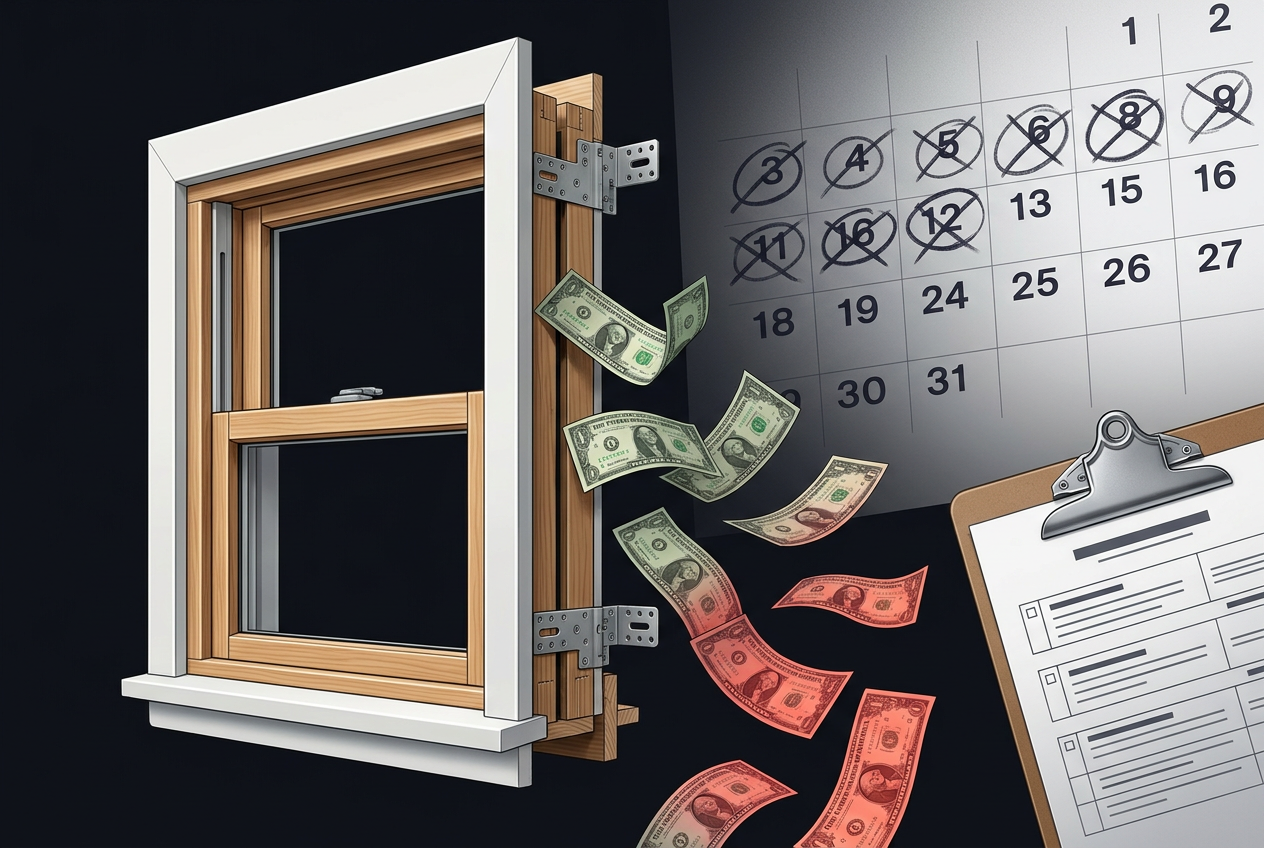
The problem is that agreeing to phase the work without restructuring your window replacement pricing will cost you money even if the homeowner pays both invoices in full. You will mobilize your crew twice, manage two separate material orders, carry overhead across two install dates separated by months, and accept the risk that phase two never happens. If you price the project as a single scope and split the invoice, you are underpricing the actual work you will perform.
Phased installations are not the same project delivered in two pieces. They are two distinct projects that happen to share a homeowner and an original estimate. Your pricing must reflect that difference or your margin will disappear into the scheduling gaps.
What Phasing Actually Costs
When you price a full-house window replacement, your estimate assumes one site visit for measurement, one material order with volume pricing, one delivery, one crew mobilization, one set of travel and setup costs, and one final walkthrough. Your overhead allocation reflects the efficiency of completing related work in a concentrated block.
Splitting that scope across two install dates changes every one of those assumptions.
You now need two crew mobilizations, which means two trips to the jobsite, two vehicle costs, two setup periods, and two days when your crew is not generating revenue at full capacity. If the phases are separated by a season, you may need two separate material orders because holding inventory for six months ties up cash and warehouse space. You will manage two invoicing cycles, two sets of homeowner communications, and two opportunities for scheduling friction or change requests.
Your overhead does not pause between phases. You still carry insurance, payroll burden, rent, and truck payments during the months when phase two is deferred. If you allocated overhead evenly across the original fifteen-window scope and the homeowner only completes phase one, you recover a fraction of the cost required to keep your business operating while that project sat in your pipeline.
The larger operational risk is that phase two never converts. The homeowner's financial situation changes, they decide to sell the house, or they hire a different contractor who prices the remaining eight windows as a standalone project and undercuts your original per-unit rate. You completed phase one at a blended rate that assumed full project overhead recovery, and now you are left with a job that did not cover its true cost.
How to Structure Phased Pricing
The answer is not to refuse phased work. Many homeowners have legitimate reasons for splitting installations across seasons or budget cycles, and accommodating that flexibility can win you projects that competitors walk away from. The answer is to price each phase as if it were a standalone estimate, then offer a modest discount if the homeowner commits to both phases under a single contract up front.
Start with phase one. Price the first-floor windows as a complete project with full overhead recovery. Include your standard markup for mobilization, project management, and gross margin. If that phase involves seven windows and your normal pricing would yield a total of eleven thousand dollars for those units as part of a larger job, your phase-one price should be twelve thousand five hundred or thirteen thousand, reflecting the fact that this is now the only guaranteed revenue from this homeowner and must carry the full weight of the costs required to execute it.
Then price phase two the same way. Treat the second-floor windows as a separate door installation estimate with its own mobilization, material handling, and overhead allocation. If those eight windows would have been thirteen thousand dollars in the original blended estimate, price them at fifteen thousand as a standalone phase.
If the homeowner wants both phases and is willing to sign a single contract that commits to both install dates, offer a combined price that splits the difference. Your total might be twenty-five thousand dollars for both phases under contract, compared to the original twenty-four thousand you would have charged for a single continuous install. You recover the additional cost of phasing, the homeowner receives a modest incentive for committing up front, and you eliminate the risk that phase two evaporates.
When to Require Full Contract Signature
The decision to require a single contract covering all phases depends on how much risk you are willing to carry and how confident you are that the homeowner will follow through.
If the project is large, the gap between phases is longer than ninety days, or the homeowner is vague about timing for the second phase, require full contract signature before you begin phase one. Structure the payment schedule so that each phase is invoiced separately, but make it clear that both scopes are committed and that canceling phase two after phase one is complete will trigger a cancellation fee equal to your mobilization and material restocking costs.
This approach protects you from the homeowner who uses your phase-one pricing to get the most visible work done, then shops around for a cheaper option on the remaining scope. It also forces the homeowner to make a real commitment rather than treating phase two as an indefinite maybe.
If the gap between phases is short, the homeowner has a specific calendar constraint like a family event or a planned vacation, and the total project value is modest, you can price each phase independently and treat phase two as a new inquiry when the homeowner contacts you to schedule it. This gives the homeowner maximum flexibility and reduces the risk that you are managing a contract with deferred obligations that complicate your cash flow and scheduling.
The middle ground is to provide pricing for both phases in a single proposal, note that the phase-two price is valid for sixty or ninety days, and explain that if the homeowner proceeds with phase one but delays phase two beyond that window, you will need to re-quote based on current material costs and crew availability. This keeps the door open without locking you into pricing that may no longer reflect your costs six months later.
Pricing Multi-Phase Projects Without Losing the Bid
The most common objection to this approach is that pricing each phase as a standalone project will make your total price higher than a competitor who simply divides the original estimate in half and calls it phased. That competitor is either underpricing the work or planning to make up the difference with change orders and delays.
Your job is not to match a price that does not reflect the true cost of phased installation. Your job is to explain to the homeowner why phasing costs more and what they are paying for.
Walk them through the mechanics. Explain that mobilizing your crew twice means two days of travel and setup instead of one. Show them that ordering materials in two shipments often eliminates the volume discount you would have received on a single order. Make it clear that holding pricing and crew availability across a six-month gap carries risk for you, and that risk has a cost.
Most homeowners understand this once it is explained. They are not trying to game the system; they are working within budget or timing constraints and need to know what their options actually cost. If you present phased installation pricing as a legitimate accommodation with a transparent cost structure, you will win the homeowners who are serious about completing the work and lose the ones who were never going to follow through on phase two anyway.
The contractors who lose these bids are the ones who agree to phase the work, divide the original price in half, and hope the homeowner does not notice that they are absorbing the extra cost. That approach wins the estimate but loses money on the job, and it trains homeowners to expect phased work at no additional cost.
When Phasing Makes Sense Operationally
Not every request to phase work is a problem. Some scenarios make phasing operationally neutral or even beneficial, and in those cases your pricing can reflect the reduced risk.
If the homeowner wants to phase work by building area but the phases can be completed in the same week, you are not adding meaningful cost. Replacing all the windows on the first floor Monday and Tuesday, then moving to the second floor Wednesday and Thursday, is still a single mobilization with continuous crew utilization. You can price this as a single project with a staggered install sequence rather than two separate phases.
If you have a scheduling gap in your calendar that aligns with the homeowner's preferred timing for phase two, phasing actually improves your crew utilization. A homeowner who wants phase one in October and phase two in February may be filling a slot you would otherwise struggle to book during the slow season. In that case, you can price phase two at standard rates rather than adding a premium for the split.
If the homeowner is a repeat client or a referral source who has sent you multiple projects, the risk that phase two will not convert is lower. You can offer closer-to-blended pricing as a relationship investment, knowing that even if this particular phase two falls through, the long-term value of the relationship justifies the concession.
The key is to evaluate each phased request based on the actual operational and financial impact rather than defaulting to either always allowing it at no extra cost or always refusing it.
The Overhead Recovery Problem
The hidden damage in underpriced phased work shows up in your overhead recovery at the end of the quarter. You look at your revenue, your completed project count, and your gross margin, and the numbers do not match your expectations. You sold the projects, your crew performed the work, and the homeowners paid, but your profit is lower than your pricing model predicted.
The problem is that phased projects broke the relationship between revenue and cost that your pricing assumes. You invoiced for fifteen windows but mobilized your crew, managed logistics, and carried overhead for two separate projects. Your pricing model allocated overhead based on project count or revenue, but the actual cost was tied to the number of distinct jobsite engagements, and phasing doubled that count without increasing your overhead recovery.
This is why phased installation pricing must treat each phase as a separate project for overhead allocation. If your standard overhead rate is thirty percent of direct costs and you normally apply it once per project, a phased project needs that thirty percent applied to each phase. Otherwise you are recovering sixty percent of the overhead required to deliver the work, and the missing forty percent comes out of your net margin.
Contractors who do not track this distinction discover it when they notice that their margin on phased projects is consistently lower than their margin on single-phase projects of the same size, even though the scope and per-unit pricing were identical. The difference is not in the material cost or labor efficiency; it is in the unrecovered overhead that phasing introduced.
The Change Order Parallel
Phased pricing is structurally similar to pricing a change order. When a homeowner asks you to add three windows to an existing project after the original contract is signed, you do not price those windows at the same per-unit rate you offered in the original estimate. You price them higher because adding scope mid-project requires additional coordination, a second material order, and often a return trip to the jobsite.
The same logic applies to phased work. Phase two is a change order that happens to have been discussed during the original estimate. It requires separate mobilization, separate coordination, and separate risk, and your pricing should reflect that.
The clearest way to communicate this to the homeowner is to present the original full-scope estimate alongside the phased alternative. Show them that completing all fifteen windows in one continuous install costs twenty-four thousand dollars, while splitting the work into two phases costs twenty-six thousand five hundred dollars unless they commit to both phases up front, in which case the total is twenty-five thousand. The homeowner can see the cost of flexibility and decide whether it is worth paying for.
This transparency also protects you from the accusation that you are inflating prices when the homeowner circles back for phase two. You are not changing your pricing; you are applying the pricing structure you disclosed at the beginning.
What to Say When the Homeowner Pushes Back
Some homeowners will ask why phasing costs more when the scope has not changed. They see fifteen windows either way and assume the price should be the same.
The answer is that the scope has changed. The scope is not just the number of windows; it is the structure of the work, the timeline, the number of jobsite engagements, and the risk that you are agreeing to manage. Phasing changes all of those variables.
You can explain it this way: "If I replace all fifteen windows in one install, I bring my crew to your house once, order all the materials together, and complete the work in two days. If we phase the work, I'm bringing my crew twice, managing two separate schedules, and holding pricing and availability for phase two even though we don't have a start date yet. That coordination and risk has a cost, and the phased price reflects it."
Most homeowners accept this once they understand the mechanics. The ones who do not are often signaling that they are not serious about phase two, in which case you have successfully avoided underpricing a project that would have cost you money.
Protecting Margin Across Seasons
One of the most common phasing requests is seasonal. The homeowner wants the ground-floor windows replaced now and the upstairs windows done next spring, or they want the front of the house done before the holidays and the back of the house after winter.
Seasonal phasing introduces additional risk because your costs may change between phases. Material prices fluctuate, labor costs increase, and your crew availability tightens or loosens depending on the season. If you lock in pricing for phase two at the time of the original estimate, you are accepting the risk that your costs will rise before that phase begins.
The safest approach is to price phase one as a firm quote and provide a budgetary estimate for phase two with a note that final pricing will be confirmed thirty or sixty days before the scheduled install. This allows you to adjust for cost changes without surprising the homeowner with a dramatically different number.
If the homeowner insists on locked pricing for both phases, build a contingency into the phase-two price that reflects the uncertainty. If you expect material costs to remain stable, add five percent. If the gap between phases is longer than six months or you are seeing volatility in your supply chain, add ten percent. The homeowner is paying for price certainty, and that certainty has a cost.
When to Walk Away
Not every phased project is worth taking. If the homeowner wants to phase work across more than two install dates, if the gap between phases is longer than a year, or if the homeowner is unwilling to commit to a timeline or pricing structure for the later phases, the operational complexity and financial risk outweigh the value of the project.
You can politely decline by explaining that your scheduling and pricing systems are designed for projects with defined timelines and that open-ended phasing creates too much uncertainty for both parties. Offer to provide a full-scope estimate that the homeowner can execute when they are ready to proceed with the entire project, and stay in touch so you are top of mind when their situation changes.
Walking away from a poorly structured phased project protects your margin, your crew's schedule, and your cash flow. It also signals to the homeowner that your pricing is not negotiable and that you run your business with clear policies and realistic expectations.
The Long View
Phased work is a tool for accommodating homeowners who have legitimate constraints, not a default approach to door installation estimates or window replacement pricing. When phasing makes operational sense and the pricing reflects the true cost, it allows you to win projects that would otherwise go to competitors or disappear entirely.
When phasing is underpriced, it turns completed projects into margin losses and trains homeowners to expect flexibility without cost. Your pricing structure is not just about recovering costs on a single job; it is about establishing the principle that your work, your coordination, and your risk have value, and that value does not disappear just because the homeowner wants to split the timeline.
Homeowners who need phased installations are looking for contractors who can manage complexity and deliver quality work across multiple engagements. Your pricing should reflect that capability. When you structure pricing for multi-phase projects around true cost recovery and clear commitments, you attract homeowners who are serious about completing the work and you protect the margin required to grow a sustainable business. That distinction separates qualified opportunities that turn into profitable proposals from inquiries that consume your time and leave you wondering why you are working harder but earning less.