
Why Partial Siding Jobs Kill Margin and How to Price Them Right
Partial siding estimates look smaller and easier to win, but material matching, trim complexity, and warranty exposure destroy margin faster than most contractors realize.
- Published
- Reading time
- 13 min
- Topics
- sidingestimatingpricingmargin
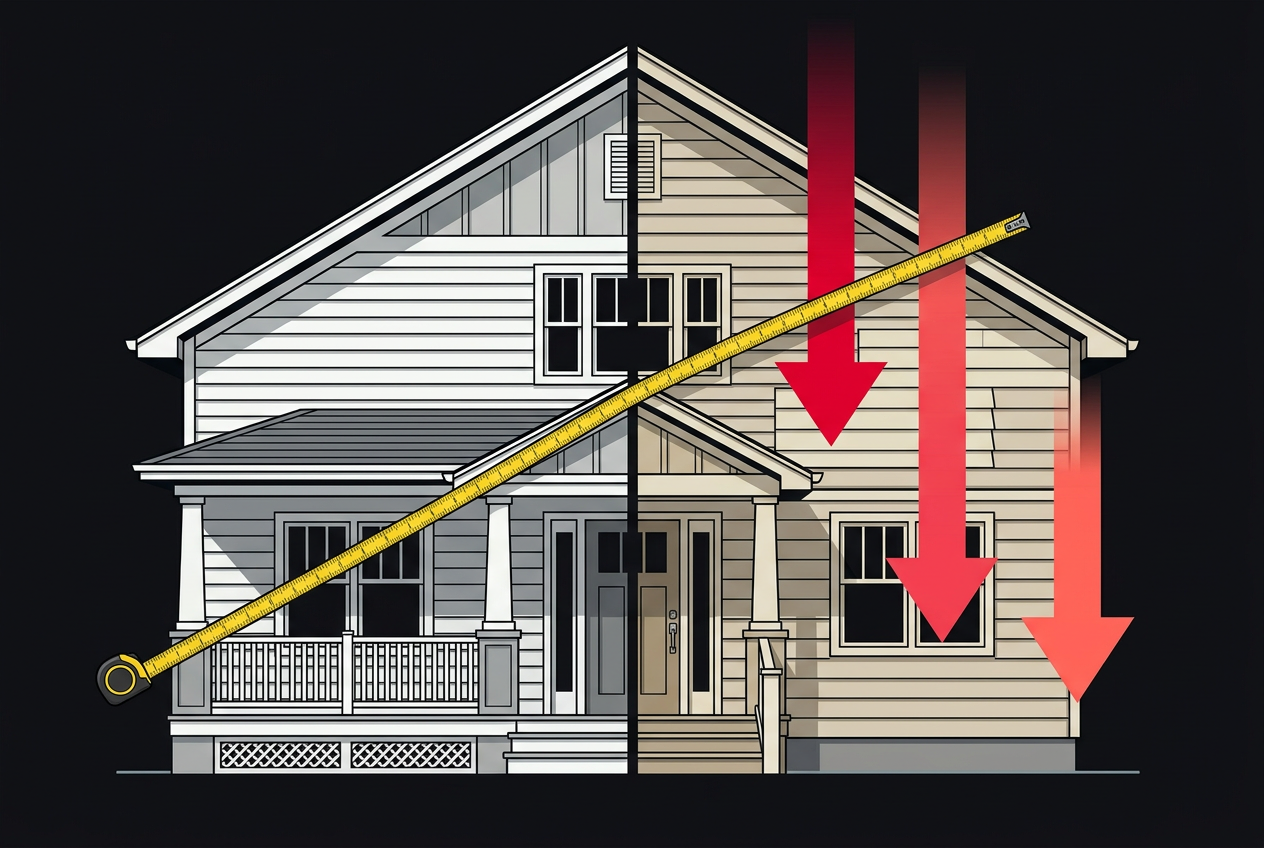
Partial siding replacements destroy more contractor margins than almost any other residential project category. A homeowner calls and asks for "just the back" or "the west side where the sun damage is worst," and the inquiry feels easy: smaller scope, faster install, lower material cost, simpler sale. Then you run the numbers after the job wraps and realize you made less per day than a straightforward full-house re-side that took three times as long.
The problem is not the homeowner's request. The problem is how most siding contractors structure partial replacement estimates, treating them like miniature versions of whole-house jobs instead of the specialized, margin-sensitive projects they actually are.
The hidden costs
Partial siding work carries cost layers that do not show up in your full-house pricing model. Every one of them erodes gross margin if you quote the job as simple square-footage math.
Material matching is the first killer. The homeowner's existing siding has faded, discontinued colors, or a profile that manufacturers phased out two product cycles ago. You spend hours tracking down a supplier who stocks something close, pay a premium for special-order material, or settle for a near-match that the homeowner questions during the walk-through. Even when you find an exact SKU, dye lots shift. Vinyl and fiber cement age differently depending on sun exposure and climate. The new section will look newer, and that contrast becomes your problem when the homeowner expected invisible repairs.
You cannot bill for three hours of supplier calls and sample comparisons unless you price that time into the estimate up front. Most contractors do not, because the line item feels awkward to defend and the homeowner is already price-sensitive on a partial job.
Trim and transition details multiply fast. A full re-side gives you clean runs, consistent corners, and economies of scale on J-channel, soffit, and trim. Partial work forces you to match existing trim profiles, tie into old corners without tearing them out, and create transitions that hide the seam between old and new material. Each transition point requires custom cuts, caulk, touch-up paint if the trim is wood, and extra labor to make the joint look intentional instead of like a patch.
If you replace the back of a house, you now have two vertical seams where the new siding meets the old on the side elevations. Those seams need flashing, careful lap alignment, and often a color-matched caulk bead that will weather differently than the siding itself. That is two or three additional hours of finish work that does not exist on a full wrap, and every hour costs you margin if it is not in the estimate.
Waste is worse on partial jobs. You still order material by the square or the box. A partial replacement on one elevation might need seven squares, but the material ships in increments that leave you with leftover product you cannot use on the next job because the color and profile will not match. On a full house, leftover material covers repairs, waste cuts, and starter strips. On a partial job, leftover material sits in your shop until you toss it.
You also lose efficiency in labor. Your crew mobilizes, sets up scaffolding or ladders, pulls permits if required, and stages materials. Those fixed costs do not scale down proportionally when the job shrinks from 24 squares to eight. A two-person crew might finish a partial job in a day and a half instead of four days, but the setup, teardown, and travel time is nearly identical. Revenue per mobilization drops.
Warranty and callback exposure is higher. When you replace all the siding on a house, you own the entire envelope. If a leak develops, you control every seam, every flashing detail, and every penetration. When you replace one side, you inherit risk from someone else's install. The old siding might have improper flashing, missing housewrap, or rotted sheathing that you discover mid-job. Now you are pricing a change order to a homeowner who expected a simple partial replacement, or you are eating the cost to avoid conflict and keep the project moving.
Even if the underlying structure is sound, any water intrusion near your work becomes your callback. The homeowner will not distinguish between a leak caused by fifteen-year-old siding on the north side and new siding you installed on the south. You will spend time diagnosing and defending scope, and that time costs money whether or not you ultimately prove the problem is outside your work area.
Why contractors underprice partial work
Most residential siding contractors price partial jobs the same way they price full re-sides: material cost plus labor, multiplied by a standard margin. That method works when the job has clean boundaries, predictable material requirements, and efficient labor. It fails on partial replacements because the cost structure is different.
The homeowner is comparing your price to a mental budget, not to market rate. They know a full re-side costs fifteen or twenty thousand dollars, and they are asking for partial work specifically because they do not want to spend that much. They expect your price to be a proportional fraction of the full job. If you quote four thousand dollars to replace the back elevation and they were expecting twelve hundred, the estimate dies regardless of whether your number reflects actual cost.
That price expectation forces contractors into a bad choice: walk away from the inquiry, or lower the margin to win the work. Many contractors lower the margin, reasoning that a small job with thin margin is better than no job at all. That logic works only if the job runs exactly as planned, with no material delays, no hidden rot, and no extra trips. It almost never does.
Partial jobs feel like relationship builders. The homeowner says they will do the rest of the house next year, or they mention a kitchen remodel they are planning, or they promise to refer you to neighbors. The implied future work justifies a lower price today. Sometimes that future work materializes. More often it does not, and you are left with a completed job that did not cover its true cost and a homeowner who now anchors their expectation of your pricing to the discounted number you gave them.
The estimate process itself is faster, so the price feels like it should be lower. You spend twenty minutes measuring one elevation instead of ninety minutes measuring the whole house. The quote goes out the same day. The project feels simpler, so the price instinctively drops. But simplicity in estimating does not mean simplicity in execution, and a fast estimate that misses cost drivers is worse than no estimate at all.
How to structure partial siding estimates
A defensible partial siding estimate starts with a different pricing model than a full re-side. You are not selling square footage. You are selling a specialized scope that includes material sourcing, integration with existing systems, and acceptance of elevated risk.
Build in a material matching fee as a separate line item. Call it a procurement and coordination charge, a color-match service fee, or a material sourcing cost. The label matters less than the transparency. Explain that matching discontinued or aged siding requires supplier research, sample acquisition, and often special-order minimums that do not apply to new-construction material. Charge three hundred to six hundred dollars depending on the complexity, and include it in every partial estimate. Homeowners who balk at that fee are signaling price sensitivity that will make the entire project difficult. Let them go.
Price transitions and tie-ins by the linear foot, not by the square. Each seam where new siding meets old is a discrete task with measurable labor and material cost. Measure the seams, count the corners, and assign a unit price that reflects the extra time for flashing, caulk, and finish work. A straightforward vertical seam might be fifty dollars per linear foot; a complex corner with multiple trim pieces and a profile change might be ninety. This approach makes the estimate more granular and surfaces cost drivers the homeowner can see and approve before you start.
Add a project minimum. Partial siding jobs below a certain revenue threshold do not justify mobilization. Set a floor—twenty-five hundred dollars, thirty-five hundred, whatever your fixed costs require—and walk away from anything smaller unless it is a previous client or a strategic relationship. A project minimum also filters out homeowners who are just testing the market or hoping for a quick patch. Those inquiries waste qualification time and rarely convert to booked estimates.
Separate the estimate for underlying repairs from the siding estimate. When you find rotted sheathing, failed housewrap, or structural issues during tear-off, you need a change-order mechanism that does not surprise the homeowner or kill the job. Include a line in the original estimate that says "allowance for unforeseen substrate repair: eight hours labor plus material at cost." If you use zero hours, you credit the allowance. If you use more, you document it with photos and get written approval before proceeding. This manages expectation and keeps the project from turning into a dispute when hidden conditions appear.
Offer a full re-side estimate alongside the partial. Walk the homeowner through both options during the estimate appointment. Show the cost difference, explain the margin and warranty benefit of doing the entire house, and make it clear that partial work is not just cheaper—it is a different product with different trade-offs. Some homeowners will stretch for the full job once they see the gap is not as wide as they feared. Others will stick with the partial scope, but they will do it knowing what they are giving up. Either way, you have positioned yourself as the contractor who educates rather than the one who just gives the lowest number.
When to walk away
Not every partial siding inquiry deserves an estimate. Some projects will lose money no matter how carefully you price them, and others will consume crew capacity that could go toward higher-margin work.
Walk away when the homeowner is self-diagnosing the scope. If they insist the problem is "just the back" but you see evidence of water intrusion, failed caulk, or siding damage on other elevations, the partial job will turn into a callback. Either expand the scope to address the real problem or decline the work. Partial fixes to whole-house issues create liability without solving the homeowner's need, and you will own the fallout.
Walk away when the material is obsolete and no good match exists. Homeowners sometimes want to replace one side of a house clad in a siding profile that has not been manufactured in a decade. If the only option is a near-match that will be visually obvious, the homeowner will be unhappy even if they approved it in writing. That dissatisfaction turns into poor reviews, withheld payment, and conflict that costs more than the job was worth. Recommend a full re-side or refer them to a handyman willing to take the risk.
Walk away when the project is in a service area you rarely work. Partial jobs already carry lower revenue than full re-sides. If you add an hour of drive time each way, the math collapses. Unless the homeowner is willing to pay a travel fee that covers the cost, the estimate is not worth the fuel.
Walk away when your schedule is full of higher-margin work. Opportunity cost is real. A partial siding job that nets you fifteen hundred dollars over two days is a bad use of crew capacity if you have three full re-side proposals pending that would net five figures each. Seasonal demand matters. In peak season, raise your project minimum or stop quoting partial work entirely. Save that capacity for the projects that actually move your business forward.
Pricing for the right homeowner
Partial siding jobs do have a place in a residential contracting business, but only when they are priced to reflect their true cost and sold to homeowners who value quality and understand trade-offs.
The right homeowner for a partial siding job is dealing with isolated damage from a storm, a failed building component like a dryer vent that caused localized rot, or a section of siding that took impact from a fallen tree. They understand that the repair is surgical, not cosmetic. They care more about durability and a weather-tight envelope than about a perfect color match. They are willing to pay for the expertise required to integrate new material with an existing system.
The wrong homeowner is trying to stretch a small budget across a large problem, hoping that replacing the most visible elevation will make the house look updated without the cost of a full re-side. They will compare your price to the lowest handyman quote, question every line item, and expect the result to look like new construction. Those projects are not worth the margin erosion and relationship friction they create.
Building the estimate workflow
Qualification starts before you drive to the property. When a homeowner calls or submits an inquiry asking for partial siding work, ask why they want partial instead of full replacement. The answer tells you whether the project is damage-driven and scope-appropriate or budget-driven and likely to be a pricing fight.
Ask what material is currently on the house and approximately when it was installed. If they do not know, ask for photos of the existing siding including close-ups of the profile and any fading or damage. Those photos let you research material availability before you invest time in an on-site estimate. If the product is discontinued and no substitute is available, you can decline the inquiry over the phone and save ninety minutes.
During the estimate appointment, measure the partial scope but also walk the entire house. Document the condition of all elevations with photos. If you see issues outside the requested scope, note them in the estimate and explain the risk of leaving them unaddressed. This protects you from scope creep and gives the homeowner the information they need to make an informed decision.
When you present the estimate, do it in person or over a video call, not by email. Walk through the line items, explain the material matching process, and show examples of previous partial jobs if you have them. Let the homeowner ask questions and surface objections in real time. This is where you learn whether they understand the cost or whether they were hoping for a number half of what you quoted. If it is the latter, you can walk away before you waste follow-up time.
What this means for your business
Partial siding estimates affect more than individual job margin. They shape your overall revenue mix, crew utilization, and cash flow predictability.
If you price partial work correctly, it becomes a reliable source of smaller projects that fill gaps in your schedule without bleeding margin. A well-priced partial job can be a one- or two-day project that keeps a crew productive between larger re-sides, generates positive cash flow, and builds relationships with homeowners who may need full replacements down the road.
If you underprice partial work, it becomes a trap. Your schedule fills with low-margin jobs that feel busy but do not generate the profit needed to cover overhead, pay your crew competitively, or invest in marketing and tools. You work harder, book more estimates, and end the season wondering why your bank account does not reflect the activity.
The discipline to walk away from underpriced partial jobs is the same discipline that protects crew capacity for the projects that matter. Every estimate you decline because the math does not work is capacity you preserve for a qualified inquiry that does. Every partial job you price to reflect real cost is a signal to the market that your business values quality and expertise over volume.
Homeowners who need partial siding work done right will pay for it when the estimate is transparent, the scope is clear, and the contractor demonstrates understanding of the complexity involved. Homeowners who just want the cheapest number will always find someone willing to give it to them. Let them.
Partial siding jobs are not inherently bad business. Partial siding jobs priced like miniature full re-sides are. The difference is a pricing structure that accounts for material matching, trim complexity, waste, and risk—and the confidence to walk away when the project does not meet your minimum. That structure turns partial inquiries into qualified estimates and qualified estimates into profitable projects that use your crew capacity the way it should be used: on work that pays.