
Lock the Material Order Before You Book the Estimate
When composite decking takes six weeks to arrive, deck contractors who wait to order materials after the estimate lose crew weeks and margin to competitors with better workflows.
- Published
- Reading time
- 14 min
- Topics
- deck buildingestimatingschedulingmaterials
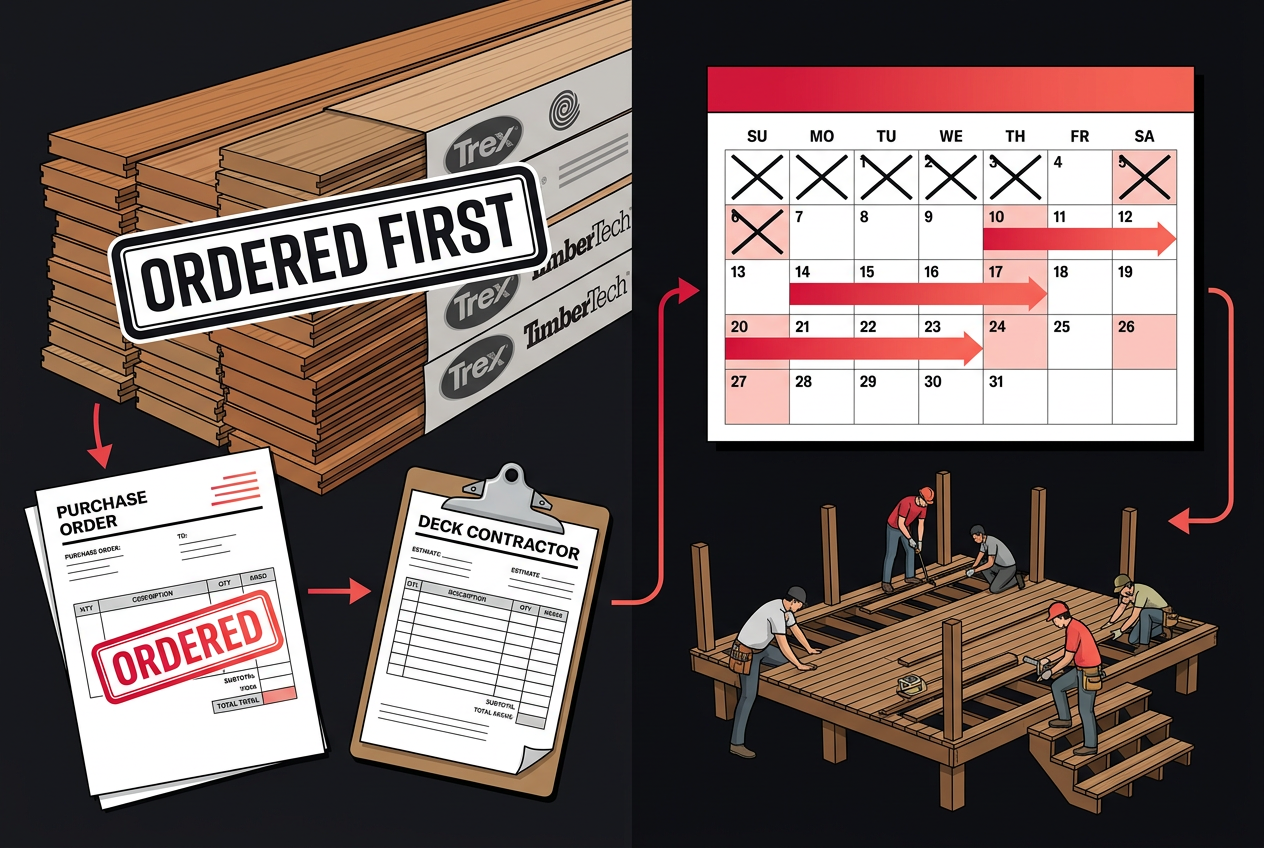
Most deck contractors structure their estimate process backward. They measure, write the proposal, win the job, collect the deposit, then order materials. When composite or PVC decking ships in three days, that sequence works. When the same material takes four to six weeks, it destroys crew utilization and hands qualified projects to competitors who locked their supply chain earlier.
The standard deck estimating process assumes materials arrive on demand. That assumption breaks when premium composite decking, hidden fastener systems, and matching trim pieces stretch into multi-week lead times. Contractors who refuse to adapt end up with crews standing idle, homeowners canceling mid-wait, or margin squeezed by price escalations they should have locked weeks earlier.
The Cost of Delayed Material Commitment
A two-person deck crew bills roughly $1,200 to $1,800 per day depending on market and project complexity. If a crew goes unbooked for five business days while waiting on decking materials that could have been ordered during the proposal stage, the contractor absorbs $6,000 to $9,000 in lost billings. Multiply that across a season with three crews and unpredictable material windows, and the revenue gap becomes structural.
The typical response is to push estimates further out, building buffer into the schedule to account for material uncertainty. That approach protects the crew from downtime but introduces a different problem: homeowners who receive a proposal in May for an August start date often accept a competitor's June proposal instead, even at a higher price, because the competitor committed to an earlier window.
Deck work is not emergency service. Homeowners plan deck projects months in advance, around summer hosting, graduations, or home sales. A contractor who cannot offer a confident start date during the proposal conversation loses deals to operators who can, regardless of price or quality differentiation.
The alternative is to flip the sequence. Lock the material order before the estimate is booked on the calendar. Treat material commitment as a qualification gate, not a post-sale administrative step.
When to Lock Pricing
Material pricing for composite decking fluctuates, but not as wildly as lumber. Most manufacturers hold pricing for 30 to 90 days once a quote is issued to a dealer or contractor. The risk is not daily spot swings; the risk is seasonal increases, tariff changes, or supply tightening that moves pricing between the time a proposal is written and the time materials are actually ordered.
Lock pricing the moment a project clears qualification and moves toward proposal. That means calling the supplier with square footage, product line, color, and fastener spec as soon as the site measure is complete. Request a written price hold with an expiration date. If the supplier will not hold pricing for 45 days, that is a signal to either find a different supplier or adjust the qualification criteria to prioritize homeowners ready to move faster.
A price hold is not a purchase order. It does not require payment. It does require the contractor to decide on product and quantity before the proposal is delivered, which forces clarity on scope and margin earlier in the sales cycle.
Some contractors hesitate to lock pricing before the homeowner commits, fearing they will eat cost increases if the deal does not close. That fear is misplaced. The larger financial risk is writing a proposal with assumed material costs, winning the job, then discovering the actual cost is 8% higher when the order is finally placed four weeks later. That scenario turns a 35% gross margin project into a 28% margin project, or worse, depending on how the proposal was structured.
Locking pricing before the proposal also eliminates a common stall tactic during the close. Homeowners often ask whether prices might drop if they wait. A contractor with a locked price hold can answer clearly: the price in the proposal is guaranteed for 30 days, and the material is available now. Waiting introduces risk to both timing and cost.
Collect Deposit, Then Order
The deposit serves two functions. It confirms the homeowner's commitment, and it funds the material order. In a normal-lead-time environment, those two functions happen in quick succession. In an extended-lead-time environment, they must happen in the correct order, or the contractor is left holding materials for a homeowner who has not yet paid.
Do not order materials until the deposit clears. This is not a trust issue; it is a cash flow and storage issue. A $12,000 composite deck material package sitting in the yard for a homeowner who signed the contract but has not yet paid ties up capital, consumes space, and creates exposure if the homeowner cancels or delays. The same package ordered after the deposit clears becomes inventory allocated to a confirmed project, not speculative stock.
The deposit should cover materials plus a portion of labor, typically 40% to 50% of the total contract. That structure gives the contractor enough cash to order materials, pay for delivery, and cover initial labor costs without dipping into operating reserves. It also signals to the homeowner that the project is moving from proposal to production.
Some contractors collect the deposit and wait to order materials until one week before the scheduled start date, treating the deposit as general working capital. That approach works only if lead times remain predictable. When lead times stretch or supply windows shift, the contractor ends up with a booked estimate, a paid deposit, and no materials on-site when the crew arrives. The result is a rescheduled start, a frustrated homeowner, and a crew that either moves to a different project or sits idle.
Order materials within 48 hours of deposit clearance. Confirm the ship date with the supplier in writing. Add the ship date and the estimated delivery date to the project calendar, with a buffer. Treat the material delivery as a milestone that governs crew scheduling, not the other way around.
How to Communicate Delays
Material delays will happen. Manufacturers push ship dates. Freight carriers miss windows. The wrong color ships, or fasteners arrive without the decking. The contractor's job is not to prevent every delay, but to communicate delays before the homeowner discovers them.
The first communication about timing should happen during the proposal presentation. If the project requires composite decking with a current lead time of four weeks, state that clearly in the estimate walkthrough. Explain that the start date depends on material arrival, and that the contractor will confirm the delivery window once the deposit is received and the order is placed. Do not promise a start date until the material ship date is locked.
Once the order is placed, send the homeowner a written confirmation that includes the expected delivery date and the planned start date. If the delivery date is July 10 and the planned start date is July 15, put both in writing. That creates a shared reference point and eliminates the "I thought you were starting last week" conversation.
If the supplier pushes the delivery date, notify the homeowner immediately. Do not wait until the day before the original start date. A two-week delay communicated two weeks early is an inconvenience. The same delay communicated two days early is a credibility problem.
The notification should include three elements: the updated delivery date, the new planned start date, and the reason for the delay. Homeowners accept delays caused by supply chain issues more readily than delays caused by scheduling mistakes. Transparency on the cause protects the relationship.
Offer options when possible. If the delay is significant and the homeowner has flexibility, propose moving them earlier in the schedule if materials for another project arrive ahead of plan. If the delay pushes into a time-sensitive window—such as a scheduled event at the home—discuss alternatives, even if that means adjusting scope to use in-stock materials or pausing the project until after the event.
Do not offer a discount to compensate for a material delay unless the delay violates a contractual start date and causes the homeowner measurable harm. Material delays are a supply chain reality, not a service failure. Discounting teaches homeowners to expect price concessions whenever timing shifts, which undermines margin on future projects.
Sequencing Multiple Projects
A deck contractor running two to four crews during peak season will have multiple projects in the pipeline at different stages: some in proposal, some awaiting deposits, some with materials on order, some with materials on-site, and some in production. The challenge is not managing any single project; the challenge is sequencing all of them when material delivery windows are unpredictable.
The solution is to separate the project pipeline into two queues: the estimate pipeline and the production pipeline. The estimate pipeline includes inquiries, qualified opportunities, scheduled estimates, and proposals awaiting decision. The production pipeline includes projects with deposits received, materials on order or on-site, and start dates assigned.
A project moves from the estimate pipeline to the production pipeline only when three conditions are met: the deposit has cleared, the materials are ordered, and the delivery date is confirmed in writing by the supplier. Until all three conditions are met, the project remains in the estimate pipeline and does not receive a crew assignment.
This separation prevents a common scheduling trap. A contractor books an estimate, assumes the homeowner will sign, pencils in a start date for the crew, and then discovers the homeowner needs another week to decide or the material lead time is longer than expected. The crew is now assigned to a project that is not ready, and other qualified projects get pushed back to accommodate a start date that was never firm.
Instead, assign crews only to projects in the production pipeline. If no projects in the production pipeline are ready for the next available crew slot, use that time for service work, small repair projects, or advancing estimates. Do not hold crew capacity open for a project that has not cleared the deposit-and-material gate.
When multiple projects are in the production pipeline with overlapping delivery windows, sequence them by material arrival date, not by sale date or homeowner preference. The crew should move to whichever project has materials on-site and is ready to start. A homeowner who signed first but whose materials arrive second starts second. Communicate this clearly during the proposal stage, so expectations are set before the contract is signed.
If two projects have materials arriving in the same week, prioritize by project size and margin. A five-day deck replacement with 38% margin takes precedence over a three-day repair with 25% margin, assuming both homeowners have flexibility. If one homeowner has a hard deadline, that overrides margin sequencing, but only if the deadline was disclosed during qualification and written into the contract.
Protecting Margin During Long Lead Times
Extended material lead times compress decision windows and amplify the cost of errors. A contractor who writes a proposal with assumed material costs, waits three weeks for the homeowner to decide, then discovers the price hold expired and costs increased, now faces a choice: eat the increase and deliver the project at lower margin, or rewrite the proposal and risk losing the deal.
The better approach is to write every proposal with a 30-day acceptance deadline tied to the material price hold. If the homeowner does not sign within 30 days, the proposal expires and must be rewritten with updated material pricing. That structure protects margin and creates urgency without artificial pressure.
Some homeowners will ask for an extension. Grant it only if the supplier extends the price hold. If the supplier will not extend the hold, explain to the homeowner that material costs are no longer guaranteed and the proposal must be updated. Reissue the proposal with current pricing and a new 30-day window. Do not absorb cost increases to preserve a deal that took too long to close.
Another margin risk is scope creep during the material-order phase. A homeowner signs the contract for a 300-square-foot deck in gray composite, then calls two days later asking to switch to a two-tone color pattern with picture-frame borders. If materials have not been ordered, the change is manageable. If materials were ordered 48 hours after deposit clearance, the contractor is now holding inventory that does not match the revised scope.
The solution is a change-order policy with a cutoff. Changes to materials, dimensions, or design are accepted until the material order is placed, at no additional fee if they do not affect total cost. After the material order is placed, any change that requires new materials incurs a restocking fee, a design fee, and a schedule delay. Put that policy in the contract and repeat it verbally when the deposit is collected.
Long lead times also create risk around cancellations. A homeowner who signs in May for an August start has three months to change their mind, encounter a financial disruption, or sell the home. If materials are ordered in May and the homeowner cancels in July, the contractor is left with $8,000 in inventory that may not fit the next project.
Mitigate this risk with a cancellation clause tied to material orders. If the homeowner cancels before materials are ordered, the contractor retains a percentage of the deposit as a booking fee—typically 10% to 20%—and refunds the rest. If the homeowner cancels after materials are ordered, the contractor retains the full material cost plus the booking fee. That structure ensures the contractor is not penalized for the homeowner's change of plans.
Multi-Project Buffer Strategy
When supply windows are unpredictable, the production pipeline must be deeper than crew capacity. A contractor running two crews should have three to four projects in the production pipeline with deposits and materials on order. That buffer ensures that if one project's materials are delayed, another project is ready to fill the crew's schedule.
Building that buffer requires pushing more opportunities through the estimate pipeline and converting proposals faster. It also requires higher qualification standards. A contractor who books ten estimates per month and converts three is generating 1.5 projects per crew, assuming two crews. That is not enough buffer when material delays push projects by two to four weeks.
The same contractor who tightens qualification, books eight estimates per month, and converts four is now generating two projects per crew. That extra 0.5 projects per crew creates the buffer needed to absorb material delays without crew downtime.
Qualification for deck projects during extended lead times should include timing flexibility. A homeowner who must start by a specific date because of a scheduled event is a higher-risk opportunity than a homeowner who is flexible within a four-week window. The flexible homeowner is easier to sequence when materials arrive late. The homeowner with a hard deadline introduces schedule risk that must be priced into the proposal or declined during qualification.
Material Storage and Staging
A deeper production pipeline means more materials arriving and sitting on-site before crews are ready to start. A contractor with four projects in the pipeline may have $30,000 to $40,000 in composite decking, railings, and fasteners staged in the yard or at job sites. That inventory must be protected from weather, theft, and mix-ups between projects.
Composite decking can sit outside, but it should be elevated, covered, and separated by project. Each pallet or bundle should be labeled with the project address, homeowner name, and delivery date. Fasteners, flashing, and trim pieces should be stored inside if possible, or under tarps if not.
Staging materials at the job site before the start date introduces theft risk and homeowner anxiety. A homeowner who sees $10,000 in decking sitting in their driveway for ten days starts calling the contractor asking when work will start. Deliver materials to the site one to two days before the crew arrives, not earlier.
If site delivery is not practical because of access, delivery fees, or supplier scheduling, stage materials in the contractor's yard and transport them the day before the start. That adds a labor and logistics step, but it protects materials and manages homeowner expectations.
Why Competitors Win on Speed
A deck contractor who books an estimate, delivers a proposal, waits for the homeowner to sign, collects the deposit, orders materials, waits four weeks for delivery, then schedules the crew is giving every faster competitor a six- to eight-week window to steal the project.
The competitor who qualifies harder, locks material pricing during the proposal stage, orders materials the day the deposit clears, and books the start date based on a confirmed delivery window is compressing that cycle to three to four weeks. The homeowner perceives that contractor as more organized, more confident, and more likely to deliver on time.
Speed is not about rushing the homeowner or cutting corners on estimates. Speed is about eliminating dead time between the stages of the estimate process. Dead time is the four days between site measure and proposal delivery. Dead time is the two weeks the proposal sits in the homeowner's inbox. Dead time is the three days between deposit clearance and material order. Dead time is the gap between material delivery and crew arrival.
A disciplined deck contractor estimate workflow eliminates dead time by treating each stage as a gate with a clear trigger. The site measure triggers the proposal. The proposal triggers the material price hold. The deposit triggers the material order. The delivery confirmation triggers the crew assignment. When each stage happens in sequence without delay, the entire process compresses, and the contractor books more estimates into confirmed starts before competitors enter the conversation.
Extended composite decking lead times do not reduce the number of homeowners who want decks. They only reduce the number of contractors who can deliver decks on time without killing crew utilization. Contractors who adapt their estimate workflow to lock materials early, communicate delays transparently, and sequence projects by material arrival will win the qualified opportunities that other contractors let slip into scheduling limbo.