
Stop Bundling Maintenance Into Hardscape Estimates
Mixing installation projects with recurring maintenance in your estimate pipeline splits crew focus, clouds capacity planning, and destroys project margin visibility.
- Published
- Reading time
- 12 min
- Topics
- landscape estimatingcrew capacityhardscape pricing
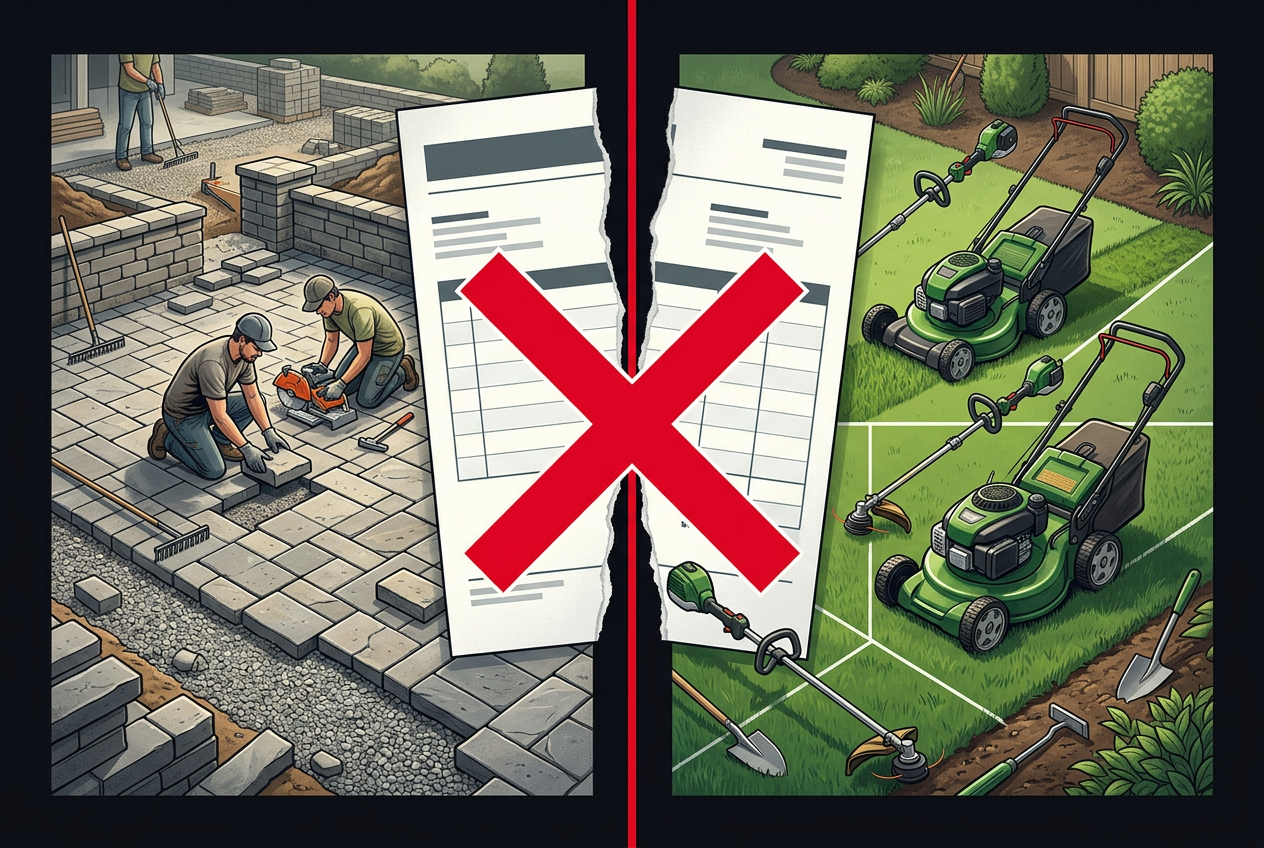
Most landscape contractors sabotage their own estimate pipeline before they ever meet a homeowner. They treat a $35,000 patio installation and a $200-per-month mowing contract as variants of the same sale. They bundle ongoing service into project proposals, list "seasonal maintenance packages" alongside retaining wall line items, and wonder why their close rate stalls and their crew schedule looks like a jigsaw puzzle someone dropped.
The problem is not the upsell. The problem is pretending that a one-time hardscape installation and a recurring maintenance contract belong in the same estimate, on the same timeline, priced with the same logic, and delivered by the same crew structure.
They do not. Conflating them clouds your estimate queue, splits your crew capacity, and makes it nearly impossible to measure the profitability of either.
Different Projects, Different Operations
A landscape design-build estimate for hardscape installation—patios, retaining walls, grading, outdoor kitchens, fire pits—requires hard skills, specialized equipment, and project-based labor. You price by scope, calculate material and subcontractor costs, schedule around weather and permitting, and move crew from one finished job to the next. Gross margin depends on accurate material takeoffs, efficient sequencing, and the ability to finish on schedule without call-backs.
Maintenance is the opposite. It is recurring revenue tied to a subscription model. Labor is predictable but lower-skill. Equipment is mowers, trimmers, blowers—not excavators and plate compactors. Scheduling is route-based, not project-based. Profitability depends on density within a service area, equipment uptime, and minimizing drive time between stops. You do not sell maintenance by the square foot of sod; you sell it by the month, and you price to cover weekly or biweekly visits across a season or a year.
Bundling them into a single proposal forces you to answer questions that have no clean answer. Do you schedule the maintenance crew to start the week after installation wraps, or do you wait until spring? Do you assign the same crew that built the patio to mow it? Do you price maintenance to subsidize the hardscape bid, or price hardscape to justify signing a maintenance contract the homeowner may cancel after six months?
Every version of that compromise costs you clarity, margin, or both.
Capacity Planning Fails When You Mix Models
Landscape contractors operate with finite crew capacity. If you run two install crews and one maintenance crew, you can handle a predictable number of projects and service stops per week. The moment you try to cross-staff—pulling install labor to cover a maintenance route, or holding a maintenance crew on-site to help finish a paver patio—you sacrifice the productivity of both.
Install work requires focus. A two-person crew building a retaining wall cannot pause mid-pour to mow three lawns. A three-person team grading and installing drainage cannot split up to cover seasonal cleanups. When you bundle maintenance into project estimates, you create the expectation that the same team will handle both. That expectation becomes a scheduling conflict the moment your install pipeline fills up or your maintenance route density grows.
Maintenance work requires route density. Profitability depends on clustering stops within a tight service area and minimizing windshield time. If you commit to maintaining a homeowner's property as part of a patio install, but that property sits fifteen miles outside your usual maintenance zone, you either absorb the drive time and destroy your margin, or you skip the stop and lose the revenue you already sold.
Capacity planning depends on knowing what kind of work is in your pipeline and what resources it requires. When your estimate queue mixes $40,000 outdoor kitchen projects with $150-per-month lawn care add-ons, you cannot forecast labor, equipment, or cash flow with any accuracy. You cannot tell a homeowner when you can start their retaining wall if half your calendar is blocked by maintenance routes you sold as part of previous design-build estimates.
Separating the two lets you schedule installs around project timelines and hard skills, and route maintenance around density and efficiency. It also lets you say no to maintenance work that does not fit your service area or crew structure without walking away from the installation sale.
Pricing Logic Breaks Down
Hardscape pricing depends on material cost, labor hours, equipment, subcontractor fees, permit costs, and the complexity of site conditions. You estimate a patio by calculating square footage, base prep, paver type, edge restraint, polymeric sand, compaction, grading for drainage, and the number of days a skilled crew will spend on-site. You build in contingency for weather delays and add margin to cover overhead and profit.
Maintenance pricing depends on property size, frequency, scope of service, and competitive rates within your market. You estimate a mowing contract by calculating the time it takes to mow, trim, edge, and blow, then multiply by visits per month and months per season. You price to cover labor, fuel, equipment wear, and a margin that reflects the lower skill and lower risk of the work.
The two models do not share a common cost structure. Trying to blend them into one proposal forces you to either underprice the installation to make the maintenance look attractive, or overprice the maintenance to justify the project bid. Either way, you distort the real margin on both sides and lose the ability to evaluate profitability by service line.
Worse, you create confusion for the homeowner. A proposal that lists a $28,000 paver patio, a $3,200 outdoor fireplace, and a $1,800 annual lawn care package forces the homeowner to evaluate three completely different commitments at once. They may love the patio, question the fireplace, and resent the maintenance upsell because they already have a lawn service. Now you are negotiating three deals instead of closing one, and the maintenance add-on becomes an objection that delays or kills the project sale.
Separating the estimate lets you close the installation first, then introduce maintenance as a standalone offer after the project is complete and the homeowner has seen your crew's work. That sequencing removes friction, clarifies value, and gives you a second opportunity to earn recurring revenue without risking the project close.
The Estimate Queue Gets Clouded
Your estimate queue should tell you how many projects you can sell, schedule, and complete in the next thirty to ninety days. It should reflect the work that fits your crew capacity, your service area, and your cash flow cycle. When you mix project estimates with maintenance upsells, the queue stops being useful.
A $15,000 retaining wall and a $100-per-month trimming package both show up as open opportunities. But one generates immediate revenue and moves off your schedule in two weeks. The other generates $1,200 per year and requires ongoing crew time, route planning, and billing. They do not compete for the same resources, they do not close on the same timeline, and they do not produce the same cash flow. Treating them as equivalent opportunities makes it impossible to prioritize your pipeline or measure your true sales velocity.
Landscape design-build estimates should be evaluated on project size, timeline, decision-maker readiness, and whether the scope fits your current capacity. Maintenance contracts should be evaluated on service area fit, route density, contract length, and recurring revenue potential. Conflating the two forces your qualification process to juggle variables that do not overlap, and it makes your pipeline forecast meaningless.
Separating them lets you build two queues: one for project work that requires estimates, scheduling, and completion, and one for recurring service that requires route planning, contract terms, and renewal management. You can qualify each against its own criteria, forecast revenue separately, and allocate sales and operations resources accordingly.
Margin Visibility Disappears
Gross margin on a hardscape installation might be thirty to forty percent if you estimate accurately, manage labor efficiently, and avoid change orders. Gross margin on maintenance might be twenty to thirty percent if you maintain route density, control equipment costs, and minimize callbacks. But if you bundle both into one contract and one invoice, you lose the ability to measure either.
Did you make money on the patio install, or did you break even because the maintenance revenue subsidized a low bid? Did the maintenance contract turn profitable in year two, or are you still covering the cost of drive time you absorbed to close the project sale? Without separate pricing and separate tracking, you cannot answer those questions, and you cannot improve the profitability of either service line.
Margin analysis depends on isolating cost and revenue by job type. When you separate project estimates from maintenance contracts, you can track material cost, labor hours, subcontractor fees, and equipment rental for every installation. You can measure drive time, labor efficiency, and equipment wear for every maintenance route. You can identify which projects deliver the best margin and which maintenance contracts are worth renewing. You can adjust pricing, crew structure, and sales strategy based on real profitability data instead of blended averages that hide problems on both sides.
Separation also protects margin when a homeowner cancels. If a homeowner signs a bundled contract, completes the patio install, and cancels the maintenance piece three months later, you may have underpriced the installation in anticipation of recurring revenue you never captured. If you price and sell them separately, the installation stands on its own margin, and the maintenance contract is a bonus that does not distort the project bid.
How to Structure Separation
Start by defining what qualifies as a project estimate and what qualifies as a maintenance contract. A project estimate covers one-time installation work with a defined scope, timeline, and completion date: patios, retaining walls, grading, drainage, outdoor kitchens, fire pits, pergolas, sod installation, landscape lighting, irrigation systems. A maintenance contract covers recurring service with ongoing visits and predictable scope: mowing, trimming, edging, blowing, seasonal cleanups, mulch refreshes, pruning, fertilization, pest treatment.
Estimate and price them independently. When a homeowner requests a patio or retaining wall, provide a detailed project proposal that includes scope, materials, timeline, payment terms, and total cost. Do not include maintenance as a line item. If the homeowner asks about ongoing care after installation, explain that you offer maintenance separately and can provide a contract after the project is complete. If you want to introduce maintenance proactively, do it as a separate conversation, separate proposal, and separate close—not as an add-on to the project bid.
Qualify project inquiries based on scope, service area, decision-maker, timeline, budget if disclosed, and crew capacity. Qualify maintenance inquiries based on property location, route density, contract length, frequency, and whether the work fits your existing maintenance schedule. Do not force one qualification framework to cover both.
Track each in separate pipelines. Use your CRM or project management system to distinguish between project opportunities and maintenance opportunities. Measure close rate, average sale size, and sales cycle separately for each. Forecast revenue and crew capacity separately. Schedule installs on a project calendar and maintenance on a route map. Invoice and collect payment separately, even if the same homeowner signs both contracts.
Assign sales and operations responsibility clearly. If you run a small operation and handle both yourself, allocate time separately for project estimates and maintenance route planning. If you have multiple people, consider assigning one person or team to manage project sales and installation, and another to manage maintenance sales and service delivery. The two roles require different skills, different pricing knowledge, and different scheduling logic. Trying to do both in the same conversation or the same proposal dilutes focus and increases error.
When Homeowners Ask for Both
Homeowners often ask for maintenance as part of the project conversation. They want to know who will care for the new patio plantings, whether you offer lawn care, or if you can handle seasonal cleanups. That is a legitimate question and a reasonable upsell opportunity. The mistake is answering it by bundling maintenance into the project proposal.
Instead, explain that you handle project work and ongoing maintenance separately because they require different crews, equipment, and scheduling. Walk the homeowner through the project estimate first. Close that sale. Schedule the work. Complete the installation. Then introduce the maintenance contract as a follow-up offer, either during the final walkthrough or in a follow-up meeting a week or two after project completion.
At that point, the homeowner has seen your crew's work, trusts your quality, and understands your process. They are more likely to sign a maintenance contract because it is framed as an extension of a successful project, not a condition of the original sale. You also have better information: you know the property layout, the plant material you installed, the irrigation coverage, and the level of care the homeowner expects. You can price the maintenance contract more accurately and set realistic expectations for scope and frequency.
If the homeowner insists on seeing both proposals before committing to the project, provide two separate documents with separate pricing, separate terms, and a clear statement that each is independent. Make it easy for them to sign the project contract without signing the maintenance contract, and vice versa. Do not create a single bundled price that makes one contingent on the other.
What This Fixes
Separating landscape design-build estimates from maintenance contracts fixes five operational problems that most landscape contractors tolerate without realizing the cost.
First, it clarifies your estimate queue. You know which opportunities represent immediate project revenue and which represent recurring service revenue. You can prioritize your pipeline based on the type of work, the resources it requires, and the timeline for completion.
Second, it protects crew capacity. You schedule install crews for project work and maintenance crews for route work. You do not pull skilled labor off a retaining wall to cover a mowing route, and you do not hold a maintenance crew on-site to finish a hardscape install. Each team stays focused on the work it is equipped and trained to do.
Third, it improves pricing accuracy. You estimate projects based on material, labor, and equipment costs without distorting the bid to subsidize a maintenance upsell. You price maintenance based on route efficiency and competitive rates without inflating the cost to justify a project discount.
Fourth, it restores margin visibility. You track project profitability and maintenance profitability separately. You know which service line drives cash flow, which delivers the best margin, and where to adjust pricing, crew structure, or sales strategy.
Fifth, it increases close rates. Homeowners evaluate one decision at a time. They sign a project contract based on scope, quality, and price. They sign a maintenance contract based on trust, convenience, and the results they have already seen. Removing the bundled upsell removes friction and speeds both closes.
Connect to Qualified Estimates
Homeowners who request landscape design-build work want outdoor spaces that improve their property and fit their vision. They are willing to invest in quality hardscape installation if the estimate is clear, the timeline is realistic, and the contractor demonstrates the skill and equipment to deliver.
Your job is to qualify those inquiries, price the work accurately, and schedule the project without diluting your crew capacity or your margin with add-ons that belong in a different pipeline. Separating installation estimates from maintenance contracts gives you the clarity to close more projects, protect profitability on both sides, and build a predictable operation that matches homeowner demand to the work your crews are built to deliver.