
Most Kitchen and Bath Estimates Die from No Decision, Not Competition
A structured follow-up process helps remodelers identify serious buyers from tire-kickers, so you allocate sales capacity to winnable projects instead of chasing dead leads.
- Published
- Reading time
- 11 min
- Topics
- estimate follow-upkitchen remodelingsales process
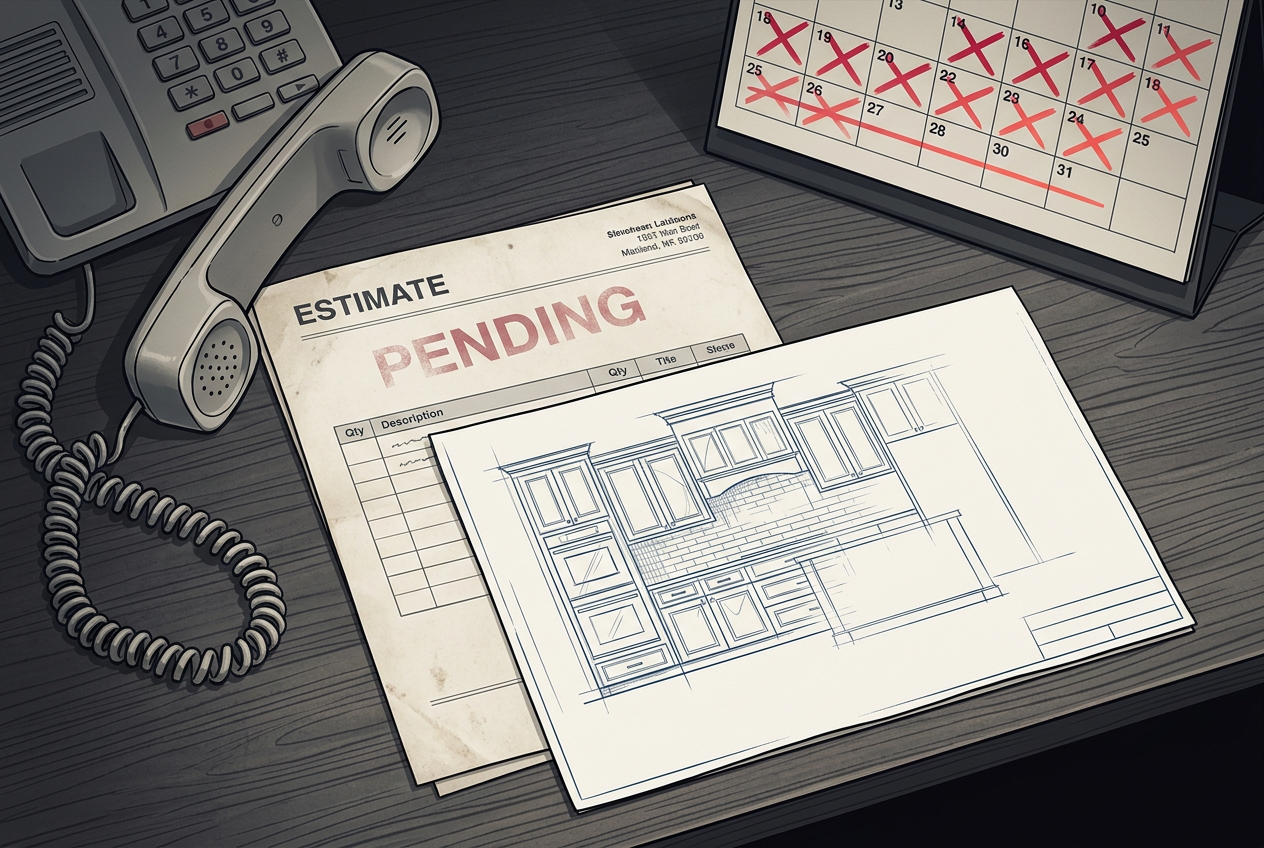
Most kitchen and bath remodelers lose more estimates to indecision than to competitors. A homeowner schedules an estimate, you spend two hours measuring and walking options, you deliver a detailed proposal—then silence. You follow up once, maybe twice, and the project evaporates. The estimate sits in your CRM marked "pending," you stop calling after three weeks, and six months later you see the finished kitchen on the homeowner's Facebook feed, built by someone else.
The problem is not your pricing or your proposal quality. The problem is that you treat estimate follow-up as an optional courtesy instead of a structured sales process. Without a repeatable system for moving qualified estimates toward a decision, you cannot tell the difference between a homeowner comparing three contractors and a homeowner daydreaming about a kitchen they cannot afford or do not have the appetite to disrupt their household for four weeks to build.
This costs you in three ways: wasted sales capacity chasing unwinnable projects, lost margin because you drop price to resurrect interest, and a distorted sense of your competitive position. When half your estimates go silent, you assume your pricing is too high. In reality, most of those homeowners were never going to buy from anyone.
Why Estimates Stall
A qualified kitchen or bath estimate means the homeowner lives in your service area, owns the home, understands the timeline, and has the decision-maker present. It does not mean they are ready to buy.
The gap between a qualified inquiry and a signed contract is decision readiness. A homeowner may want a new kitchen, may have saved money, may have scheduled three estimates—and still lack the internal alignment or urgency to commit. The spouse who was not present during your walkthrough hates the layout. The homeowner realizes they need to move $40,000 from a brokerage account and that feels more real than a Pinterest board. The tile they want is backordered until February and they are not sure whether to wait or pick something else.
None of these obstacles mean the project is dead. They mean the homeowner needs more time, more information, or a smaller decision to make before they can commit to the full scope. Your job during follow-up is to surface those obstacles, help the homeowner resolve them, and create a clear path to a signature—or determine that no path exists and move on.
Most remodelers do neither. They send the estimate, call once a week later, hear "we're still thinking about it," and then guess. Some keep calling every Friday for two months. Others assume the project is lost and never follow up again. Both approaches waste time because they do not force a decision or disqualification.
The Follow-Up Structure
Effective follow-up is not about persistence. It is about structure. You need a sequence of touchpoints, each with a specific purpose, that moves the homeowner toward commitment or disqualification within three weeks.
Day 0: Estimate delivery. Deliver the proposal in person or over video whenever possible. Walk through the scope, the timeline, the payment schedule, and the next step. Do not email a PDF and hope for a call back. When you hand the estimate to the homeowner, you control the conversation. You can address questions, clarify scope, and set the expectation for follow-up before they have time to overthink.
At the end of the estimate delivery, schedule the first follow-up. Say: "I'll check in with you on Thursday to answer any questions and talk about timing. Does morning or afternoon work better?" This is not aggressive. It is professional. You are telling the homeowner that you will follow up, when you will follow up, and why. Most will agree because you are standing in their kitchen.
Day 3: First follow-up call. The purpose of this call is to answer questions and identify obstacles. Do not ask "have you made a decision?" Ask: "What questions came up after we talked?" and "Is there anything in the scope or timeline that doesn't work for you?"
Listen for hesitation. If the homeowner says "we love it, we just need to talk about timing," that is a real obstacle. Ask when they want to start, what is driving that date, and whether an earlier or later start solves another problem. If they say "we're comparing a few options," ask what matters most to them—timeline, specific materials, payment terms—and address it directly.
If the homeowner is vague or distracted, that is a signal. You are not the priority. Note it and move to the next touchpoint.
Day 7: Adjust or clarify scope. Most estimates require adjustment. A homeowner wants the same layout but cheaper countertops. They want to add a pantry but cut the island. They want to start in April instead of January. This is normal. The second follow-up is your opportunity to send a revised proposal that reflects what you learned in the first call.
Do not treat this as a price concession. Treat it as refinement. If the homeowner asked about quartz instead of quartzite, send an updated line item and say: "Here's the quartz option you asked about. It saves $3,200 and we can still hit the same timeline." If they want to delay the start, confirm the new timeline and ask for a deposit to hold the slot.
The goal is to remove friction. Every unresolved question is a reason to delay. Every revision you make without being asked is a reason to trust you.
Day 10: Decision timeline. By the second week, you need to know when the homeowner will decide. Call and say: "We have your slot held for a March start. When will you know if you want to move forward?" This question separates serious buyers from tire-kickers.
A serious buyer will give you a date. "We'll know by Friday." "We're meeting with one more contractor Tuesday and we'll decide by the end of the week." "We need to move some money around, so probably ten days." All of those answers are fine. You now have a timeline and you can plan your next follow-up.
A tire-kicker will dodge. "We're not sure." "We need to think about it." "Maybe a few weeks." This does not mean the project is dead, but it does mean the homeowner is not actively working toward a decision. You can choose to stay in touch or move on, but you should not allocate weekly sales capacity to this lead.
Day 14: Last structured follow-up. If the homeowner gave you a decision date and that date has passed, call and ask directly: "You mentioned you'd have an answer by Friday. What did you decide?"
If they are still delaying, offer a binary choice. "I can hold your March slot through the end of this week, but after that I'll need to release it to another project. Do you want me to hold it or should we reconnect when you're ready to move forward?" This is not a pressure tactic. It is honesty. You have limited crew capacity and you need to allocate it to signed projects.
If the homeowner says "hold it," ask for a deposit. If they say "let it go," thank them and move on. Either way, you have a decision.
Day 21: Final disqualification or long-term nurture. If the homeowner has not committed after three weeks of structured follow-up, stop active pursuit. Send a final email: "It sounds like the timing isn't right. I'll check back in three months to see if anything has changed. In the meantime, feel free to reach out if you have questions."
Move the lead to a nurture list. Send a monthly email with project photos, seasonal planning tips, or material lead times. Some of these homeowners will resurface in six months when they are ready. Most will not. Either way, you are no longer spending weekly sales capacity on them.
When to Adjust Terms
The follow-up process will surface objections. Some are real and fixable. Others are polite ways of saying "no."
A real objection is specific and solvable. "We want to start in May instead of March because our daughter is home from college and we don't want construction during spring break." You can adjust the timeline. "We love the layout but the countertops put us over budget." You can offer an alternative material or a smaller island. "We're worried about the tile lead time." You can suggest in-stock options or adjust the schedule to order early.
A fake objection is vague or shifts every time you address it. "It's a little more than we wanted to spend." You ask what the budget is and the homeowner will not say. You offer a reduced scope and they say "we'll think about it." You follow up a week later and they say "we're not sure about the timeline." This homeowner is not ready to buy. Stop chasing.
The distinction matters because adjusting terms costs you time and margin. If you drop your price or expand scope to win a project that was never winnable, you lose twice—once in the margin you gave up and again in the estimate you did not attend because you were chasing a ghost.
Adjust terms for homeowners who have a clear, solvable obstacle and a stated decision timeline. Do not adjust terms to create interest where none exists.
When to Walk Away
Most remodelers wait too long to disqualify. They keep calling because the project is big, or because the homeowner was friendly, or because they have capacity in March and they want to fill it. This is a mistake.
Every hour you spend following up on a dead estimate is an hour you do not spend on a winnable project. Every time you call a homeowner who is not going to buy, you train yourself to believe that your pricing is the problem, when the real problem is that you are talking to the wrong homeowner.
Walk away when:
- The homeowner will not give you a decision timeline after two weeks.
- The objection changes every time you address it.
- The homeowner asks for a price reduction without a scope reduction.
- The homeowner schedules and cancels follow-up calls more than once.
- You get a consistent feeling that you are bothering them.
Walking away does not mean burning the relationship. It means moving the lead to passive nurture and reallocating your sales capacity to a homeowner who is comparing contractors and ready to decide this month.
The Real Conversion Problem
Most kitchen and bath remodelers assume that conversion is a function of price, proposal quality, or sales skill. It is not. Conversion is a function of timing and decision readiness. A homeowner who is ready to start in sixty days and has three estimates in hand will choose someone this month. A homeowner who wants to remodel "someday" will not, regardless of your pricing or your charm.
The follow-up process does not create urgency. It reveals urgency. A structured sequence of touchpoints forces the homeowner to either move toward commitment or admit they are not ready. Both outcomes are useful. One gets you a signed contract. The other gets you your time back.
The contractors who close kitchen and bath estimates at the highest rate are not the cheapest or the most aggressive. They are the ones who can tell the difference between a homeowner who needs one more conversation and a homeowner who needs six more months. They spend their sales capacity on the former and stop chasing the latter.
Building the System
A follow-up process only works if it runs without you remembering to do it. That means scheduled tasks, templated emails, and a clear definition of what moves a lead from one stage to the next.
After every estimate delivery, create a follow-up task for day three. After the first call, create a task for day seven. After the second call, create a task for the decision date the homeowner gave you. If you use a CRM, automate reminders. If you use a notebook, block time every Tuesday and Friday to work your follow-up list.
Template the emails and scripts. You do not need to rewrite "checking in to answer questions" every time you call. You need a repeatable way to ask the same questions, surface the same obstacles, and move toward the same decision points. Repetition is not robotic. It is professional.
Track outcomes by stage. How many estimates do you deliver each month? How many move to a second follow-up call? How many result in a scope adjustment? How many sign within three weeks? How many disqualify? You cannot improve what you do not measure, and most remodelers have no idea where their estimates die because they never defined the stages.
Allocating Sales Capacity
The purpose of a structured follow-up process is not to convert every estimate. It is to help you allocate sales capacity to the estimates you can convert.
If you deliver twelve kitchen estimates in a month and close three, that is a 25 percent close rate. Most remodelers assume the other nine were lost to price or competitors. In reality, five were probably not ready to buy, two chose someone else, and two are still deciding. If you can identify the five who are not ready by day ten instead of day forty, you can reallocate that time to the two who are still deciding—and maybe close four instead of three.
That difference is not about working harder. It is about working on the right projects. A qualified estimate is only valuable if the homeowner is ready to decide. A structured follow-up process sorts the ready from the not-ready in three weeks instead of three months, so you spend March talking to homeowners who will sign in April instead of chasing homeowners who will never call you back.
The kitchen and bath remodelers who fill their calendar with high-margin projects are not the ones who never lose an estimate. They are the ones who lose fast, learn what the homeowner needs, and move on when the answer is "not yet." They know the difference between a tire-kicker and a serious buyer by day ten, and they only spend sales capacity on the latter.
Homeowner demand for kitchen and bath remodeling is strong. The constraint is not lead volume. It is your ability to identify which leads will turn into signed contracts in the next thirty days and allocate your time accordingly. A structured follow-up process makes that possible.