
Quote the ductwork or own the change order
When homeowners ask for equipment pricing and you discover failing ducts, the estimate you write determines whether you protect margin or eat rework.
- Published
- Reading time
- 9 min
- Topics
- hvacestimatingpricingscope
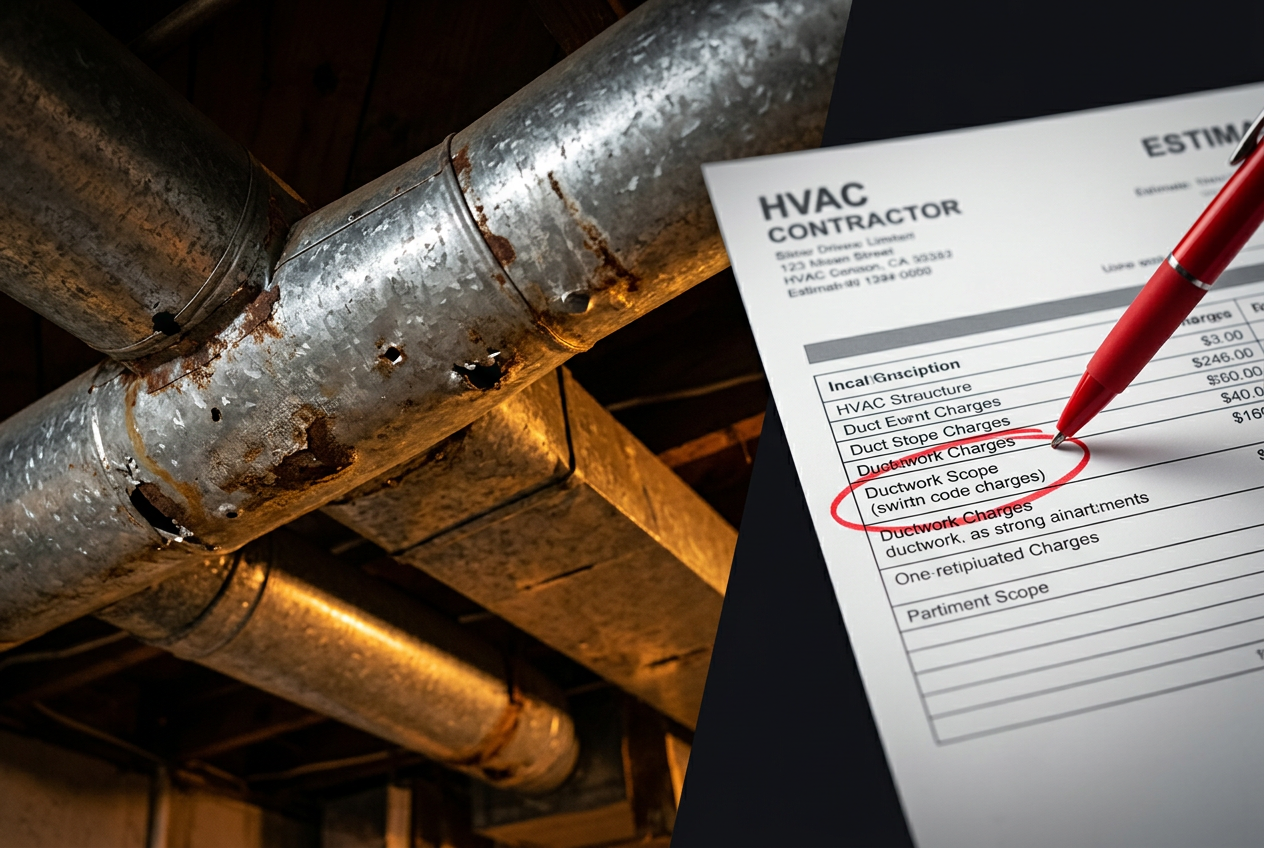
The homeowner calls for a furnace replacement quote. You walk the mechanical room, measure the existing unit, confirm clearances, and write up a straightforward swap. Three hours into the install, your lead tech pulls you aside: the return plenum is rotted through, two trunk lines are undersized, and the flex duct in the attic is compressed under insulation. You can finish the equipment swap and leave the system underperforming, eat six hours of unquoted duct labor to make it right, or call the homeowner mid-job with a change order that triples the price.
None of those options protect your schedule, your margin, or your reputation.
The problem is not that ductwork fails. The problem is that most HVAC contractors treat the estimate appointment as equipment selection theater instead of a diagnostic walkthrough, then structure pricing around the box the homeowner asked for rather than the system the house actually needs.
Surface the duct scope during the walkthrough
The moment you agree to quote only the equipment, you transfer duct risk from the homeowner's budget to your crew's schedule. Most residential HVAC systems hide their problems behind drywall, above ceilings, or under insulation. The only way to prevent mid-install surprises is to look for them before you write the estimate.
Walk the entire air distribution path, not just the mechanical room. Pull the filter, inspect the return plenum, and photograph any rust, separation, or code violations. Go into the attic or crawlspace with a flashlight and check trunk line sizing, flex duct condition, and support spacing. If the system has zone dampers, confirm they operate. If the house added square footage since the original install, measure the register count and compare it to the load calculation.
Most duct failures present visible evidence during a twenty-minute walkthrough. Collapsed flex duct reduces airflow and overworks the blower. Undersized returns create negative pressure and pull unconditioned air through building cavities. Leaking supply trunks waste capacity and drive up runtime. Rotted plenums fail code and create liability.
When you find a duct issue, photograph it and note the location. If the issue affects system performance or violates code, it belongs in the estimate scope. If it represents deferred maintenance that will fail within the service life of the new equipment, it belongs in the estimate conversation.
Present the problem without killing the deal
Homeowners ask for equipment pricing because they see a failed furnace or aged AC unit, not because they understand air distribution. When you surface duct problems during the walkthrough, you shift the frame from a simple replacement to a system correction. How you present that shift determines whether the homeowner sees you as a trusted advisor or an upselling vendor.
Separate observed conditions from recommended scope. Describe what you found, explain why it matters, and connect the duct issue to the performance or longevity they expect from the new equipment. Avoid catastrophic language and contractor jargon. Instead of "your ductwork is shot," say "the return plenum has rust perforation that will leak conditioned air and fail inspection."
Most homeowners accept duct corrections when the explanation links directly to comfort, efficiency, or code compliance. A homeowner who budgeted eight thousand dollars for a furnace swap will often stretch to eleven thousand when you show them the undersized return and explain that the new unit will short-cycle and overheat without correction. They resist when the explanation sounds like a list of optional add-ons with no clear connection to the original ask.
Frame duct corrections as a choice, not a requirement. Walk through what happens if they replace the equipment without addressing the ducts: reduced efficiency, shorter equipment life, comfort complaints, and the likelihood of a future service call that costs more than fixing it now. Then present tiered pricing that separates the equipment-only scope from the corrected-system scope.
Structure tiered pricing that protects margin
When you write a single-price furnace replacement quote that assumes perfect ductwork, you either win the job and discover problems mid-install, or you lose to a competitor who made the same assumption. When you write a padded quote that buries duct contingency in the equipment line, you price yourself out against contractors who ignored the ducts entirely.
Tiered pricing solves both problems. It qualifies the homeowner's real budget, sets expectations for discovered scope, and creates a decision point before you commit crew time.
Option A: Equipment replacement only. Include the furnace or AC swap, startup, and commissioning. Exclude all duct modifications. Add a explicit limitation: "This proposal assumes existing ductwork is properly sized, sealed, and code-compliant. Any duct corrections required during installation will be quoted separately and may delay completion." Price this option at your standard equipment-swap margin. This tier protects you from the homeowner who insists they only want the box and will not pay for duct work under any circumstances. It also creates a paper trail when that same homeowner calls angry after you discover problems on install day.
Option B: Equipment replacement with observed duct corrections. Include everything in Option A, plus the specific duct repairs or replacements you documented during the walkthrough. Itemize each correction with a location and reason: "Replace rusted return plenum in basement mechanical room (code compliance)" or "Add second return duct to master bedroom zone (eliminate negative pressure)." Price each line at full loaded labor and material cost. This tier reflects the actual scope required to deliver a properly functioning system. Most qualified buyers choose this option when the explanation is clear and the pricing is defensible.
Option C: Full duct evaluation and optimization. Include everything in Option B, plus a comprehensive duct assessment, load calculation, and any additional corrections required to meet Manual D design standards. This tier appeals to homeowners who care about long-term performance, resale value, or who experienced comfort problems with the old system. It also protects margin on larger homes or complex layouts where the walkthrough revealed multiple deficiencies. Price this option at premium margin. You are selling engineering and system performance, not commodity equipment.
Tiered pricing forces the budget conversation before the calendar commitment. A homeowner who balks at Option B pricing either does not have the funds, does not trust the diagnosis, or does not value the correction. All three scenarios kill deals or breed change orders. Better to surface the gap during the estimate than during the install.
Qualify budget and timing together
Duct corrections extend installation time. A furnace swap that takes four hours becomes a two-day job when you add plenum replacement, trunk line upsizing, and return duct addition. If your calendar is booked six weeks out and the homeowner expects installation within the week, the duct scope becomes a scheduling conflict before it becomes a pricing conflict.
Ask about timing and budget in the same conversation. "If we proceed with the equipment-only option, we can schedule you within two weeks and complete the work in one day. If we include the duct corrections I showed you, we need two days and the earliest available slot is four weeks out. Which approach fits your timeline and budget?"
Most homeowners optimize for speed when the system is dead and the season is extreme. They optimize for quality when the existing equipment still functions and they have time to plan. Understanding that priority during the estimate prevents the scenario where you book a one-day equipment swap, discover duct failures on site, and either eat the labor or extend the job into days your crew is already committed elsewhere.
Duct scope also affects material lead times. Standard trunk fittings and flex duct ship within days, but custom plenum fabrication or specialty registers can push weeks. If the estimate includes duct work that requires fabrication or special order, communicate lead time before you commit a start date.
Avoid scope creep with clear exclusions
Even with tiered pricing and documented walkthrough findings, some duct problems do not surface until you remove the old equipment or open the walls. The difference between an estimate that protects you and one that invites conflict is how you handle discovered conditions.
Include a standard exclusions section in every HVAC replacement estimate that involves ductwork. Spell out what triggers additional pricing: concealed duct damage not visible during the walkthrough, asbestos or lead abatement, structural modifications required for code compliance, duct cleaning, and corrections to work performed by others. Define the change-order process upfront: homeowner approval required before proceeding, pricing provided within 24 hours, schedule adjustment communicated immediately.
Exclusions are not a trap door for upselling. They are a shared understanding that residential HVAC systems contain variables you cannot fully assess without demolition. Homeowners accept change orders when the estimate prepared them for the possibility and the process is transparent.
Protect the crew schedule and project margin
The worst version of an HVAC replacement estimate is the one that assumes best-case conditions, prices the job at break-even to win the bid, and leaves your lead installer to manage the fallout when reality diverges from the quote. That approach does not protect margin. It does not protect the schedule. And it does not protect the relationship with the homeowner, who expected a one-day swap and now faces a multi-day job with unplanned cost.
Duct corrections belong in the estimate for the same reason foundation issues belong in a bathroom remodel quote: because you saw evidence during the walkthrough, because the work cannot proceed correctly without addressing them, and because the homeowner's budget and timeline depend on knowing the full scope before you start.
When you write a furnace replacement quote that includes observed duct corrections, itemizes the labor and material, and explains why each correction matters, you qualify the opportunity before you commit the crew. The homeowner who cannot or will not pay for necessary duct work is not a qualified estimate. They are a scope conflict waiting to detonate mid-install.
When to walk away from the estimate
Not every HVAC replacement inquiry converts to a booked job, and not every booked job should be taken. If the walkthrough reveals duct issues that triple the price and the homeowner insists on equipment-only pricing, you face a choice: accept the job knowing you will either eat labor or issue a change order, or decline the work and preserve crew capacity for qualified projects.
Walking away from underqualified estimates protects margin and schedule predictability. A homeowner who dismisses documented duct failures, refuses to discuss budget, or demands immediate installation without allowing time for proper scope assessment will not become a satisfied client. They will become a one-star review that blames you for problems you warned them about in writing.
Qualification is not about finding homeowners who agree to everything you recommend. It is about finding homeowners who understand the scope, accept the timeline, and have the budget to proceed. When those three factors align, the estimate converts to a booked job that your crew can complete on schedule without surprises. When they do not align, the estimate wastes calendar slots that could have gone to qualified opportunities.
Connect estimate structure to won projects
Every HVAC replacement estimate is a forecast. You are forecasting the labor hours, the material cost, the timeline, and the margin. When that forecast assumes perfect ductwork and the house delivers failed plenums and undersized returns, the job becomes a loss before your crew finishes the install.
Structuring the estimate to include discovered duct scope does not guarantee won projects, but it qualifies the buyer's real budget and surfaces deal-killing gaps before you commit the crew. It separates homeowners who can afford a proper system correction from homeowners who can only afford the equipment box. And it protects the margin and schedule predictability that determine whether your HVAC replacement work generates profit or just keeps the trucks moving.
The homeowner who calls for a furnace replacement quote does not know their ducts are failing. Your job during the estimate appointment is to show them what you found, explain why it matters, and price the correction before it becomes a mid-install emergency. When you do that work upfront, the estimate becomes a tool for qualification instead of a template for scope creep.